

From its socially-hyped Strawberry Sando to runaway demand for its gluten-free Colin the Caterpillar cakes, M&S is no stranger to seeing its food innovations go viral.
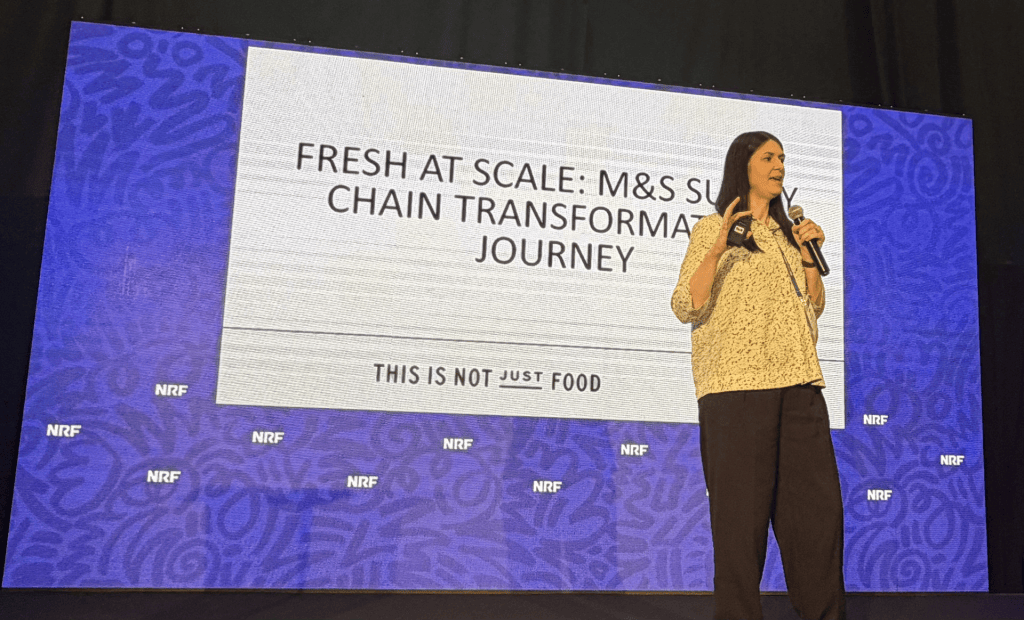
While launching new food innovations every week helps keep ranging fresh, drives sales spikes and reaches new customers, viral product success doesn’t come without creating its own challenges, Susan Massicot, Head of Supply Chain at M&S Food, said at NRF Europe.
Speaking on the Exhibitor Big Ideas stage, she explained how virality can be a double-edged sword for retailers. While unpredictable demand spikes can generate overnight sales surges, the impact can be quickly felt across the supply chain, risking availability issues, stockouts and crinkles further upstream if there isn’t enough responsiveness built in to adapt effectively.
Taming viral demand
Massicot explained that M&S Food already leverages AI to power forecasting, supplier collaboration and create more responsiveness within its operations.
The retailer has spent the last five years transforming its supply chain, using RELEX’s machine learning and AI solution. However, managing viral demand requires more than increasingly sophisticated forecasting capabilities.
“I mean, I would love a crystal ball to get that right every time,” she said, “but when you launch a sweet sandwich for the first time in the UK, you’ve got no idea what it’s going to do.”
Instead, the retailer is focusing on building the upstream planning capabilities and supplier responsiveness needed to react to unpredictable spikes in demand, ensuring that viral success doesn’t translate into empty shelves and disappointed customers.
Recent research from invent.ai suggests that 61% of consumers become frustrated when retailers don’t anticipate demand for viral items, with shoppers expecting brands to use demand sensing to pre-empt inventory levels and ensure product availability.
Supply chains that can respond to the unpredictable
With over 1,000 UK stores and an average of 7,000 products per store, M&S Food faces significant demand-planning complexity, Massicot explained.
The majority of the retailer’s sales come from short-life products, many with shelf lives of just five or six days, while its chilled and fresh supply chain operates a stockless distribution model, with products moving directly through depots to stores.
This means M&S must plan stock allocations against supplier order cycles that can begin five or six days before products reach its stores, creating an additional challenge when demand suddenly accelerates.
For viral products, Massicot suggested that supplier collaboration and operational flexibility are therefore just as important as the forecasting technology itself.
“What’s really important when we launch products that we think are going to go viral is those supplier partnerships… It’s making sure we work closely with our suppliers to understand what their [reaction] speed will be, what their bottlenecks might be [and] what we need to put in place to be really successful end-to-end,” she said.
By focusing on understanding potential hiccups and constraints before products launch, the business is better prepared to adapt, rather than simply passing unexpected pressures further along the supply chain: “It’s all about the upstream, rather than the system side; it’s very much about the upstream planning.”
While AI helps improve supply chain readiness – from identifying patterns across historical sales or external demand signals – entirely new products, or goods that unexpectedly go viral on social, provide little precedent or basis on which to model future sales.
For M&S, the answer is not simply to improve prediction accuracy, but to ensure that the wider supply chain has the flexibility and capacity to respond when forecasts are exceeded.
AI frees time for human judgement in demand planning
M&S has been working with RELEX to introduce machine learning-based forecasting, ordering and replenishment across its Food operations, bringing all its Food categories onto a single platform in March last year.
By automating much of the forecasting and replenishment process, M&S has reduced the need for manual interventions, allowing its supply chain teams to focus more attention on planning future product launches and collaborating with commercial and innovation colleagues.
This is particularly important for seasonal ranges, Massicot said, where historical sales data cannot provide a direct comparison for new products.
Instead, M&S uses reference products and historical demand patterns to inform initial forecasts, supported by closer collaboration between its product, innovation and supply chain teams.
“One of the great benefits that we’ve had from automating a lot of the execution is that our teams have more time to understand the products that we’re landing and be able to forecast them well,” Massicot explained.
It points to a wider shift in how retailers can leverage AI within demand planning: rather than replacing human judgement, automation can create greater capacity for teams to focus on the commercial context, supplier relationships and operational decisions that forecasting models cannot resolve independently.
This direction of travel will see M&S connecting more of its commercial and operational decision-making through AI, with the retailer extending its RELEX implementation into space, range and display planning in 2027.
It hopes the move will allow it to bring forecasting and stock allocation closer to the merchandising decisions that influence how products are ranged, displayed and replenished across its varied store estate.






Leave a Reply