
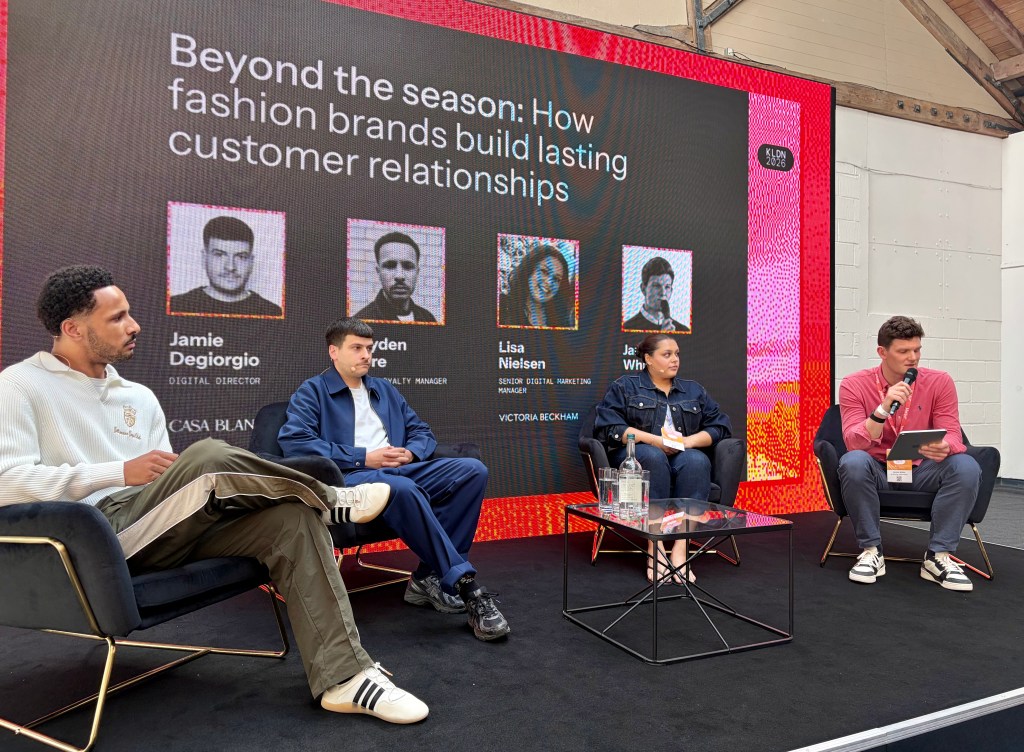
In their efforts to perfect personalisation, retailers have been too focused on data and not enough on dynamism, we heard at Klaviyo’s K:LDN event earlier this week.
On a panel exploring how brands can build lasting customer relationships, fashion labels Victoria Beckham, Casablanca and Billionaire Boys Club outlined how they are dynamically adapting customer engagement strategies as shoppers’ needs, buying behaviours and relationships with brands evolve over time.
Customers aren’t segments, they’re journeys
For all the advances in CRM, customer data platforms and marketing automation, some brands still struggle to build meaningful long-term customer relationships because they remain fixated on segments and personas, rather than treating shopper relationships as fluid, evolving journeys.
Jamie Degiorgio, Director of Digital at contemporary luxury fashion house Casablanca, described how the brand is addressing this by better understanding how customers first discover and engage with it. “People come to Casablanca in lots of different ways,” he explained, whether through luxury fashion and specific product categories, or the brand’s connections to culture via sport, travel, art and architecture.
“Understanding how data relates to shoppers, and recognising that we don’t have one customer, we have multiple customers, helps us understand what entry point they have to the brand.”
Degiorgio described how Casablanca uses those entry points into the brand to shape future shopper journeys and build deeper customer connections.
“Data helps us understand that each customer needs their own journey… we use that data to engage with customers in a way that they want to be engaged with,” he said. “It also helps us bring that customer on a journey through Casablanca as a brand, the backstory to Casablanca, and plug into many different aspects of communication with customers.”
The focus on developing deeper customer connection and communication is increasingly important within luxury retail. Recent research from a separate report by The Business of Fashion and McKinsey found that emotional connection is now the leading driver of luxury brand desirability, overtaking more traditional purchase drivers including quality, craftsmanship and exclusivity.
Billionaire Boys Club, the label founded by Pharrell Williams, is taking a similar approach. Rather than treating personalisation as a one-off segmentation exercise, its CRM & Loyalty Manager, Hayden Dore, described how the brand adapts communications as relationships mature.
“Our tone of voice remains consistent throughout that journey, but more educational within the welcome series,” he explained.
As customers engage more deeply with the brand, communications become less introductory and more reflective of the culture and community surrounding the label. “We understand that as people shop with us, that [engagement] gets a bit more relaxed, and then we start speaking our language to them.”
Data doesn’t make you a creative director
Data’s role in defining authentic and dynamic customer relationships was a central discussion point amongst the panel.
Lisa Nielsen, Senior Digital Marketing Manager at Victoria Beckham, which went live with Klaviyo in January, described how it enriches customer understanding by blending insight from digital interactions with in-store experiences.
“What happens in store, and the quality and the content that you get from a customer in store… that’s where we think it’s really rich,” she said, explaining how the brand is investing in clienteling to close the data gap between off- and online.
For Nielsen, however, the goal extends beyond simply gathering richer customer insight. “It’s just constantly having that touch point with the customer,” she explained, describing how relationship-building influences everything from customer service through to how the brand processes and applies data.
In its latest Miami pop-up store, Victoria Beckham is deploying clienteling capabilities that improve in-store CX while allowing shopper insights to flow back into its wider digital CRM and customer engagement strategy, creating a more complete picture of each customer.
Importantly, however, the panel agreed that data should be used to inform long-term customer relationships rather than dictate them.
Degiorgio described how Casablanca views its Direct-To-Consumer (DTC) data as a “pulse check” on how collections, campaigns and products are performing, but warned against allowing performance metrics to become the sole driver of decision-making.
“Data doesn’t make you a creative director,” he said. Instead, insight should be used to work towards understanding, in that moment, what customers are responding to, which will inform trends, highlight friction points and surface new opportunities. He argued data is not a replacement for brand vision, creativity or intuition, which are needed to continually evolve the brand-shopper relationship.
“Collecting that data is just a signal as to what the consumer is saying to us… that pulse check allows us to take a breath and take a step back [and assess] that moment in time.”
This contextual insight – and finding a balance between AI automation, customer context and human instinct within marketing campaigns – was central to Klaviyo’s innovation updates to its Composer and Customer Agents, which were announced at the event.
The new features help brands move towards AI that acts on customer data, rather than assists, providing the context needed to drive marketing performance and engagement.
Authenticity can’t be automated
For the panel, dynamism wasn’t just defined by continually evolving how brands engage, but also how they show up contextually to customers in authentic and relevant ways.
As brands grow into new markets, launch new collections and explore new channels, there is often pressure to manufacture relevance, chase cultural moments or pursue collaborations for impact rather than authenticity.
Dore described how Billionaire Boys Club insists that any partnership must have a real connection to its brand heritage, communities or cultural roots. Without that authenticity, the story quickly falls apart. “We won’t do a collaboration unless that’s there, it’s about storytelling; you can’t tell a story that’s not an authentic connection with a brand,” he said.
“A lot of our collabs aren’t just about selling out and being scarce, it’s more about availability, giving people what they want and, ultimately, rooting it within the heritage of the brand.”
Casablanca’s approach to storytelling and brand building mirrored this need for authenticity. Degiorgio explained that every collection, campaign and creative decision had to “make sense through our Casablanca lens,” which acts as a filter, ensuring growth doesn’t come at the expense of brand identity: “It can’t be forced, it can’t be borrowed. It’s got to be earned.”
Personalising for the future customer
The panel concluded that the next phase of customer engagement success rests in recognising that customer relationships are not static.
As consumers’ lifestyles change, priorities shift and spending habits evolve, “everyone shouldn’t get the same blanket messaging,” said Degiorgio; personalisation needs to go beyond assigning shoppers to predefined groups.
“We’re not just putting people into a cold segment and being like, you’re in this bucket and stay in this bucket forever,” he said. A customer who comes to a brand through an entry-level product, or even a resale channel, may eventually become one of its most valuable customers, just as easily as someone initially buying in just one category can later become invested in a brand’s broader story, values or community.
“We want to make sure people can develop and move through those buckets. It’s about how we personalise that experience to make sure they go from one customer segment to the next one.”
Rather than focusing data efforts on personalising for today’s customer, by far the bigger reward is to anticipate and support who that shopper may become tomorrow.
As Nielsen concluded: “If you want to future-proof your customer, you have to have a customer relationship.”





Leave a comment