
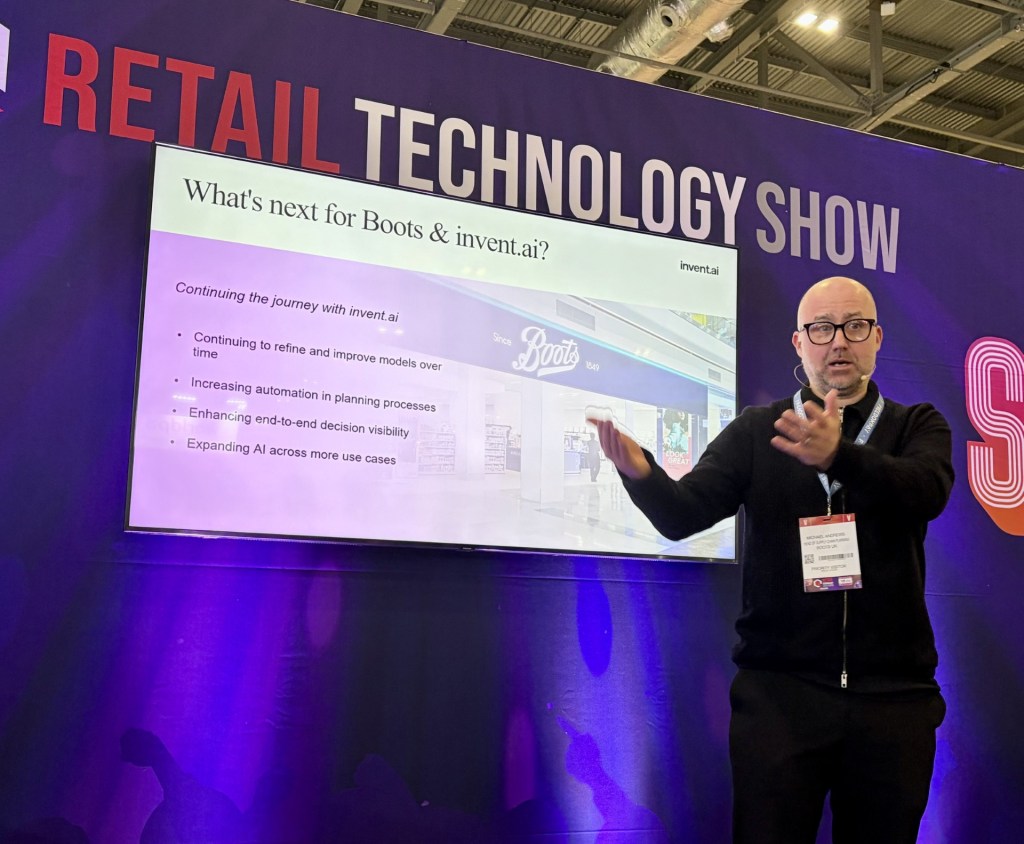
Operational complexity, increasingly volatile demand and rapidly evolving consumer behaviours were key catalysts for Boots in deciding to overhaul its forecasting capabilities, moving from traditional systems to a probabilistic, AI-led approach.
Speaking at the Retail Technology Show last week, Boots’ Head of Supply Chain Planning, Michael Andrews, and Supply Chain Systems Manager, Richard Bagley, shared how the Health & Beauty retailer moved from deterministic forecasting into a connected, fully responsive supply chain, powered by AI.
Untangling complexity at scale
Boots operates nearly 2,000 UK stores, with its bricks-and-mortar formats spanning small pharmacies through to large flagship stores, each with their own unique demand patterns. This sees the retailer managing tens of thousands of SKUs across healthcare, beauty and wellness, with each product behaving differently depending on a myriad of interconnecting factors – from location and store format to seasonality and fast-changing demand spikes.
“We have high velocity everyday items. We have highly seasonal categories. We have growing trend-driven beauty ranges. As a result, we have millions of SKUs and location combinations that all matter,” said Michael Andrews, Head of Supply Chain Planning at Boots. “On top of that, demand is constantly shifting, as are promotions, range changes and local demand patterns.”
Add to this the retailer’s growing online operations and its moves into q-commerce and rapid delivery, and Boots recognised its existing planning processes were under strain. “Boots’ demand doesn’t always come neatly from one place – it comes from stores, online, Click & Collect and delivery,” Farid Mohsen, VP of Strategic Accounts at invent.ai, added.
“As a fully omnichannel business, even small planning inefficiencies don’t stay small for long at this scale; tiny forecasting errors or allocation decisions can turn into missed sales, excess swaps or frustrated customers,” said Mohsen.
“All of that complexity is interconnected. And when the planning approach can’t keep up with that reality, the problems don’t stay inside the system. They show up in the real-world for customers and for colleagues.”
Michael Andrews, Head of Supply Chain Planning, Boots
The need for new forecasting maturity
Andrews elaborated that the infrastructure needed to run successful omnichannel operations at Boots was starting to struggle under growing complexity and scale.
“Behind the scenes, the planning maturity and efficiency of our systems didn’t really match the scale of our operations,” he said, admitting that its core forecasting and replenishment platform had been around “in one form or another” since the 1990s.
While this legacy, rules-based system had been able to function with layers of manual interventions when demand remained stable, the retailer faced an inflection point as the business’ operations and, critically, customer behaviour evolved.
“The world changed: demand became much more volatile; customer behaviours evolved; promotions became more complex; time-to-market shortened. Suddenly, the systems we were using weren’t designed for the environment we were operating in.”
With forecast positions starting to drift, complexity only increasing, manual adjustments becoming less effective and gut feel rather than data dictating decisioning, the tail was beginning to wag the dog. The knock-on impact – missed sales, excess inventory and tied up cash, space and energy – “was a real inflection point,” according to Andrews:
“We realised we couldn’t fix it by adding more rules, manual effort and resource. We needed a fundamentally different model. So, we accelerated to an AI-driven approach in partnership with invent.ai.”
“We needed something that was more responsive, more accurate and more scalable, and that improved availability and enabled faster decision-making,” Andrews continued. “We needed true end-to-end visibility, so decisions weren’t being made in silos anymore.”
Creating a connected, fully responsive supply chain
To address these challenges, Boots partnered with invent.ai to improve omnichannel forecasting accuracy, streamlining replenishment and providing clarity across its supply chain to deliver enhanced inventory visibility, accuracy and availability.
Invent.ai’s AI-decisioning platform turns retail data into real-time decisions and intelligent actions across inventory, pricing and merchandising. Working with global retailers, including Iceland, ALO and Footasylum, invent.ai drives measurable sales, revenue and margin performance while helping brands navigate dynamic markets and improve operational efficiency.
Working with invent.ai, Boots can now automate routine decisions across tens of millions of SKU and store combinations with a single, consistent view of demand and supply. This means its planners aren’t constantly correcting the system and making manual adjustments.
“One of the most important changes for us was moving away from a deterministic forecast,” said Richard Bagley, Supply Chain Systems Manager at Boots. “Now we can plan for a range of outcomes and the likelihood of each to create a probabilistic forecast. With the power of AI, it looks at a range of eventualities and how to best manage uncertainty.”
Opting for a phased approach, Boots rolled out a focused pilot with invent.ai to explore whether forecast accuracy could be meaningfully improved with manual efforts significantly decreased. Once that proof of concept was satisfied, the retailer scaled the solution across more product categories and directly integrated it into existing workloads – it is now 92% migrated across the organisation.
“Now, forecasts are continually updated using real demand signals. Always adjusting and always re-forecasting, replenishment decisions are increasingly automated,” Bagley added.
“The biggest shift is how connected everything is – teams have visibility across stores and DCs, decisions are aligned across functions. This isn’t just about better forecasting, it’s about having a more responsive, fully connected supply chain.”
Inventory becomes a performance driver rather than a cost
As a result, Boots is already seeing product availability improvements, with higher stock rates in-stores.
With the right stock, in the right place, at the right time, CX and conversions have improved, all while inventory levels (and, consequently, its working capital) have reduced, contributing to greater profitability. “Now, inventory is no longer a cost… it’s a strategic leader driving performance,” Andrews added.
Looking ahead, Boots will continue to work with invent.ai to refine and improve its AI models, increasing automation within its planning processes and driving further end-to-end visibility across the business.
Boots and invent.ai were speaking at the Retail Technology Show (RTS), the retail sector’s flagship event which took place on 22 & 23 April 2026 at London’s ExCeL.




 Retail Rewired
Leave a comment