
From Morrisons going live with Instacart’s AI smart trolleys to Waitrose mixing up its investment in new store formats to meet regional demand and online spending rebounding to a five-year high, what’s been making waves in retail this week?
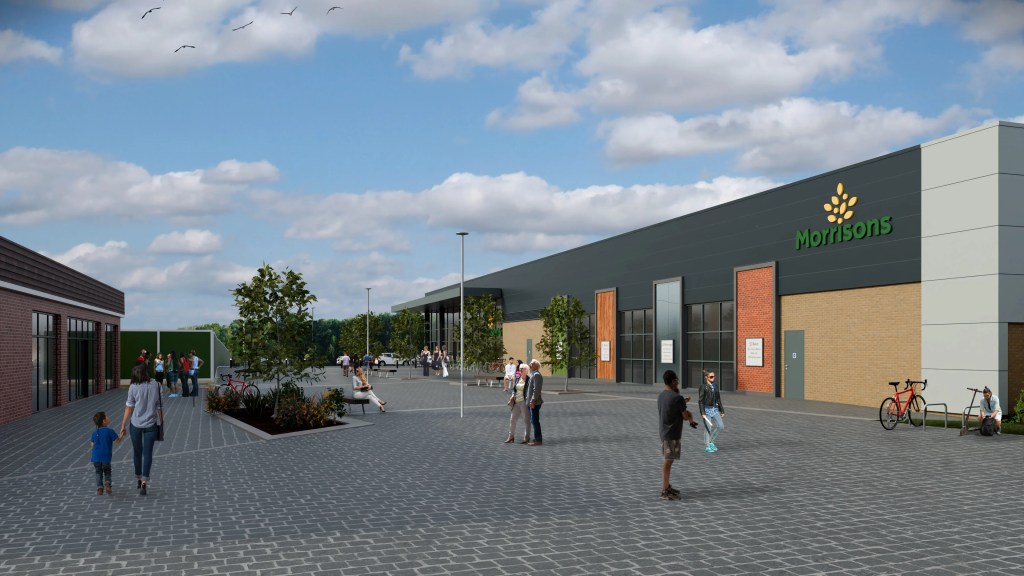
Morrisons rolls out Instacart’s AI smart trolleys in UK retail first
Morrisons has rolled out Instacart’s AI-powered smart trolleys at its Preston store, marking Instacart’s first retail partnership in the UK. The Caper smart carts aim to bring the convenience and intelligence of online shopping directly into the store.
Automatically recognising items placed in the trolley to speed up bagging and checkout, the trolleys also help shoppers keep track of their spend, make personalised product recommendations and integrate with Morrisons’ More Card loyalty scheme.
“Caper smart trolleys give customers real-time visibility of their spending, instant access to their More Card savings and a more seamless experience in the aisle,” Gordon Macpherson, Productivity Director at Morrisons, explained.
Waitrose expands store formats within its expansion strategy
Waitrose will evolve its estate expansion to focus on agility and customer choice, creating a more localised, multi-format store strategy that will match size, layout and ranging to regional demand.
The move will be supported by a £1 billion investment plan spanning its shops, online offer and partnerships across on-demand grocery and travel retail, designed to give Waitrose customers more flexibility.
This will include its ‘neighbourhood’ concept, which aims to bridge the gap between its convenience stores and full-line supermarkets, with its latest mid-sized neighbourhood store recently opening in Chelmer Village Retail Park, Essex.
“Today’s consumers no longer rely on a single weekly trip to the supermarket,” said Tina Mitchell, Waitrose’s Retail Director, adding its expansion strategy would be “shaped by adapting to how our customers live and shop.”
Stores lag behind AI experiences say 1 in 3 shoppers
Physical retail is failing to meet customers’ demands for real-time responsiveness as their expectations for more reactive retail experiences are accelerated by ecommerce and AI, the latest data from SAI, the leading active intelligence solution for stores, reveals.
Original research of over 1,000 shoppers by SAI showed that over a third (35%) believe stores are falling behind because they can’t keep pace with the speed of AI or respond to data with the same agility as ecommerce channels.
Meanwhile, six in ten (60%) of customers say retailers suffer from “blind spots” and are unaware of what’s happening on the shop floor.
“Retailers have never had more opportunities to gain visibility across their estates. Yet too often those opportunities aren’t being translated into meaningful operational insight,” said Som Sinha, Co-Founder & CEO of SAI.
“By shining a light on what’s happening across every location, retailers can reduce operational drag and deliver the responsiveness customers expect,” he added.
From aisle to AI: Unilever, Kroger & Diageo to speak at Groceryshop 2026
AI-powered shopping, retail media’s next phase of growth and the GLP-1-driven shift in consumer demand are key trends set to dominate the agenda at Groceryshop 2026.
Taking place between 22 – 24 Sep at Las Vegas’ Mandalay Bay, the event will welcome 150+ senior brand leaders to its stage, including Instacart, Unilever, Kroger, DoorDash, Sam’s Club, and Diageo.
Find out more about the keynote sessions in our preview: From aisle to AI: Unilever, Kroger & Diageo confirmed to speak at Groceryshop 2026.
“Shopping baskets in grocery, convenience and drug channels are being reshaped at once – by AI, GLP-1, and retail media,” said Rocquan Lucas, VP of Content at Groceryshop.
Lucas added that Groceryshop would “zero in” on the “decisions leaders must make right now to cut costs, grow market share, expand margins, deliver standout shopping experiences, and finalise their strategy for 2027.”
Vusion makes major RMN play with acquisition of ISM
Vusion has announced that it has agreed to acquire In-Store Media (ISM), marking a major step by the connected store technology provider in its strategy to turn stores into digital media assets and live shopper engagement hubs.
“Retail media has already transformed the economics of online commerce. The next frontier is in stores, where most shopper traffic remains and decisions of purchase are made,” said Thierry Gadou, Chairman and CEO of Vusion.
Bringing ISM’s deep expertise in RMN into the Vusion portfolio will “enhance its position in connected commerce” and “promote retail media as a core pillar of its connected store vision,” it said in a press release.
Together with ISM, it aims to build a new platform for digital in-store commerce media, connecting retailers, brands and shoppers through measurable and real-time in-store activation.
Online shopping rebounds to 5-year high
Online share of spending rebounded to a five-year high, rising to 29.4% in June, the highest level since April 2021 when covid restrictions were starting to lift, says official retail sales figures from the ONS.
It also said retail sales overall benefited from a surprise boost last month. Total retail sales rose +1%, with in-store clothing and online key performers, while revenues for the period between Apr – Jun 2026 rose +0.6% compared to the previous quarter.
“Warm weather did a lot of the work for retailers in June,” said CI&T’s Global Director of Retail Strategy and Insights, Melissa Minkow, who added seasonal holidays and World Cup watch parties also contributed to performance.
However, Retail Economics’ Nicholas Found said much of June’s momentum was “driven by timing, temperature and occasions rather than a clean recovery.”
“Beneath the headline growth, consumers remain selective… demand is there, but it is fragmented, channel-shifting and increasingly won at a competitor’s expense,” he added.
Poor deliveries risk online retailers £1.7m in lost margin annually
European ecommerce retailers could unlock over €2million (£1.71million) each year by running deliveries more efficiently and improving customer experiences in fulfilment, a new study by nShift shows.
Its new report, The ROI of Delivery Management, pinpoints the four most common sources of margin leaks – abandoned shopping carts, customer service time, returns processing and failed deliveries.
It says that, when combined, these factors can erode in excess of 60% of margins on a typical online order.
“Retailers scrutinise every penny they spend acquiring customers, yet many still accept avoidable losses throughout the delivery journey,” Jurgen Leijdekker, CEO of nShift, commented. “Every abandoned basket, unnecessary support call and inefficient return quietly chips away at margins.”

The Retail Recap is brought to you in partnership with Flagship PR, a specialist comms agency that delivers pioneering PR for retail tech.


 Retail Rewired
Leave a comment