
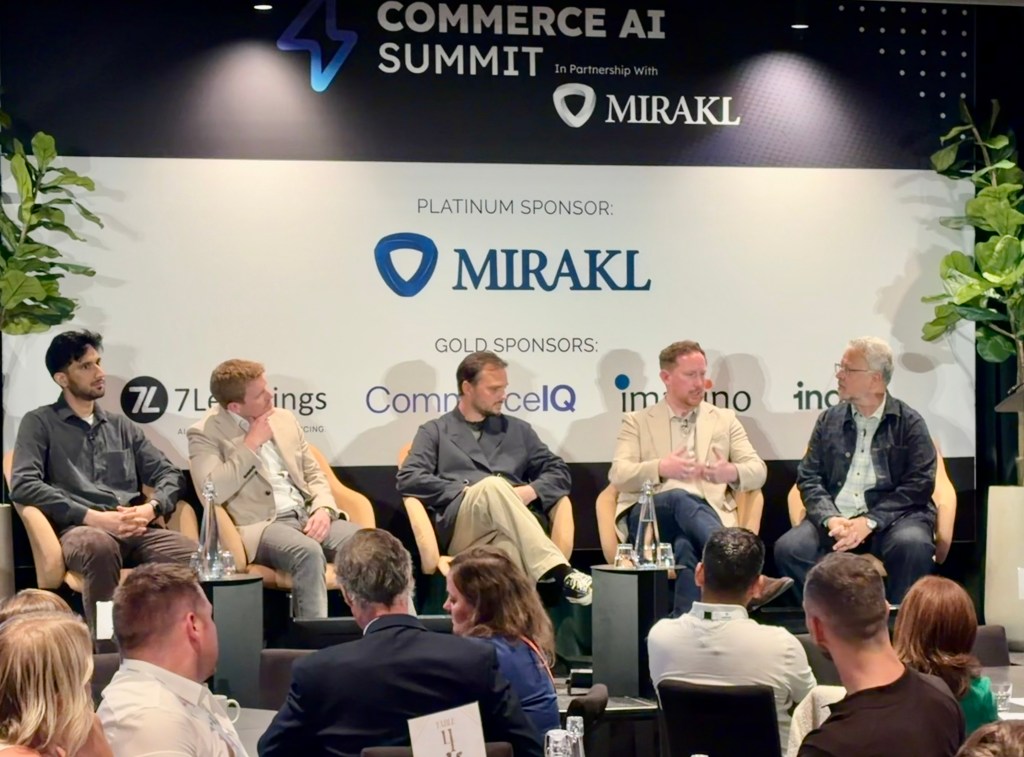
At RetailX’s CommerceAI Summit, brands and retail leaders, including Papa Johns, Reckitt and Blackcircles, explored how the AI race is entering a new phase, as retailers shift focus from productivity gains and pilots to hardwiring intelligence directly into commercial decision-making.
Operationalising AI beyond the shiny & new
While GenAI has garnered much of the attention over the past two years and with agentic now becoming the latest buzzword, several panellists across the event warned against the pitfalls of chasing shiny new innovation.
Instead, some of the most immediate business value can be created by combining emerging AI capabilities with established machine learning (ML), forecasting and decision-support systems.
David Rose, VP of International Technology at Papa Johns – or “Papa Johns’ AI Guy” as he revealed he’s referred to by his colleagues – recommended retailers focus less on chasing the latest AI and more on unlocking value from capabilities they may have had for many years but struggled to operationalise.
“AI is not that new. We’re standing on the shoulders of data scientists who have done fantastic work for a very long time.”
“The integration of data and insights into your various platforms has probably been a barrier that many people have faced… what I’m excited about today is that it looks like integration is the first thing people are trying to do,” he added.
From rule-based retail to automated decisions
For Felix Hoffmann, Founder of 7Learnings, the new blueprint for AI needs to move away from being viewed as a technology category altogether, and focus on what is actually changing inside organisations.
“What’s really happening is that human decisions are being automated,” he said.
Hoffman pointed to examples of pricing, forecasting and inventory management, which have historically relied on rigid rule-based processes, offering retailers little opportunity for agility or live fine-tuning.
Now, with AI enabling target-based decision-making, retailers’ systems can autonomously evaluate thousands of scenarios and recommend the best path to meet commercial outcomes.
“You are still fully in control, you are setting the target, but you’re not deciding on rules anymore,” he said, noting the ability of automation to remove human bias while taking some of the rigidity out of rule-setting.
Building on this, Piotr Zaleski, Co-Founder & CPTO of delivery intelligence platform Ingrid, likened the same principle to the evolution of software platforms. Rather than simply executing predefined strategies, AI is becoming responsible for recognising merchant intent and translating commercial objectives into action.
“The system can actually recognise the intent of the retailer and turn that into execution in the platform,” he said, helping move technology providers towards delivering consultancy and strategic outcomes for brands, beyond just delivering the tech itself.
Models second, organisational intelligence first
Looking ahead, several discussions pointed to the need to look past AI models, platforms or technology and concentrate on the organisational knowledge, context and decision-making frameworks businesses build around them.
“We just rent models,” said Ishaan Kaul, Global Lead of GenAI Transformation & Marketing at Reckitt. “The intelligence that we build into the systems and into the prompts is what we own.”
Stephen Dewar, Director of Marketing at Blackcircles, added to this, saying AI’s greatest value lies in unlocking critical thinking within retail teams.
“The biggest thing that AI brings to our business is the potential of those people who have the ability to really think critically.”
While access to AI technology is becoming increasingly democratised, the takeaway across the CommerceAI Summit sessions was that competitive advantage will come from how businesses apply AI.
The retailers that succeed won’t be those with access to the latest AI, but those able to combine data, expertise and institutional knowledge into systems capable of making better decisions at scale.
As the technology continues to mature, the next phase of adoption may be defined less by the intelligence inside the platform and more by the intelligence organisations build around it.
As Rose summarised: “Finally we’re getting to intelligence. It’s not just the data.”






Leave a Reply