
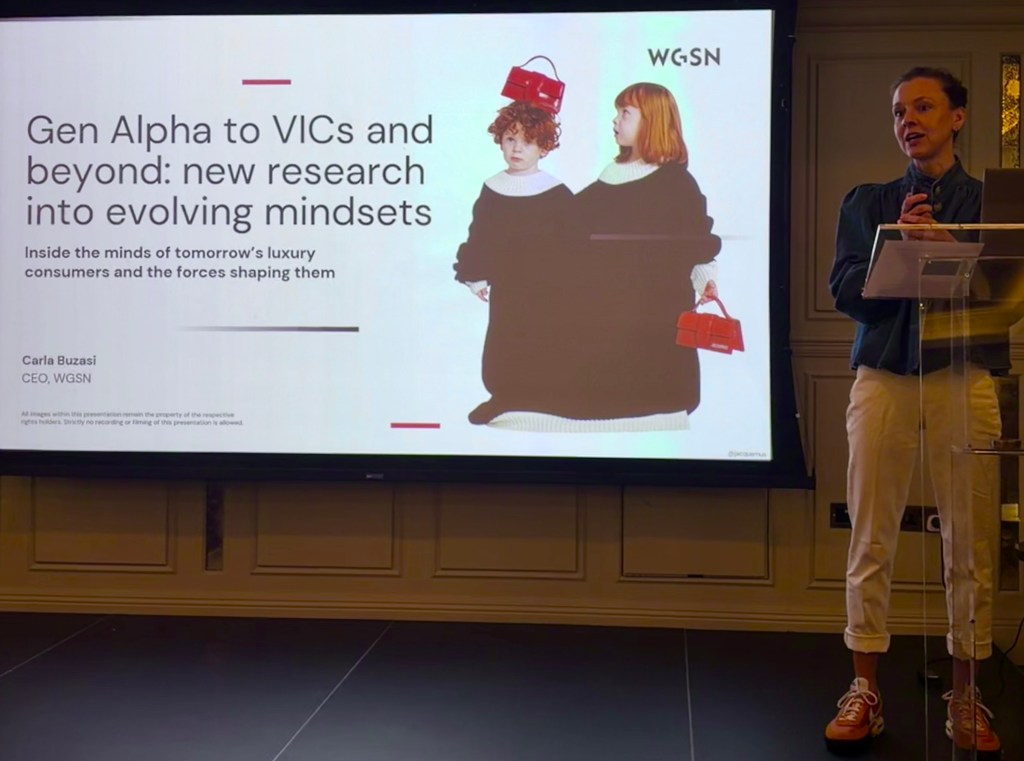
We headed to the London leg of NRF Europe’s 2026 Roadshow, a multi-market preview of what’s to come when the European retail trade show opens its doors in Paris’ Porte de Versailles in September.
Speaking at the event, Carla Buzasi, CEO of trends forecasting agency WGSN, offered insights into Gen Alpha’s buying behaviours and explored how luxury brands can win the hearts – and wallets – of this consumer cohort, which is set to become a future spending powerhouse.
Ambient affluence redefines luxury for next-gen shoppers
Raised in a world of what Buzasi describes as “ambient affluence,” Gen Alpha’s relationship with luxury is fundamentally different from any generation before it.
Unlike previous cohorts, Gen Alpha has grown up with constant exposure to premium brands, aspirational lifestyles and luxury signifiers – whether through consuming social media, engaging with digital creator culture or accessing new entry points into luxury via pre-loved marketplaces and resale platforms. Luxury is no longer viewed by Alphas as distant or unattainable.
According to WGSN’s research, 62% of Gen Alpha consumers already engage with luxury products before reaching their mid-teens, highlighting just how early exposure to premium culture now begins.
But, while this growing accessibility creates greater awareness and engagement with premium brands among Gen A, it also presents a challenge for retailers: in a world where luxury is everywhere, aspiration alone is no longer enough to drive desire.
“You’re not having to teach this generation about luxury, but there isn’t that kind of pent-up want for it that you might have seen in older generations. So, if luxury is now universal, then how do you make it meaningful again? That’s both the challenge and the opportunity for brands.”
Creating luxury demand without aspiration
As luxury is perceived by Gen Alpha as attainable, this presents a paradox that brands will increasing need to navigate, Buzasi suggested.
On the one hand, today’s youngest consumers have unprecedented exposure to luxury from an early age. Yet, on the other hand, that growing accessibility risks eroding the traditional aspiration luxury once relied upon to fuel demand.
This means luxury retailers will need to shift their role, moving from “acting as gatekeepers of exclusivity” to becoming “curators of meaningful experiences, identity and taste,” she said.
The dividing line: Gen A wants physical & digital splits
Unlike Millennials or, to some extent, Gen Zs, who tended to blend their online and physical lives, despite being digitally native, Gen A wants their online and In Real Life (IRL) experiences to be clearly delineated.
Gen A still craves physical interactions; “they yearn for those IRL experiences, they want to go and see their friends, they want that community,” Buzasi explained. And, while digital experiences remain important, they increasingly want these two worlds to serve distinct purposes rather than seamlessly overlapping.
This is evidenced in the revival of ‘Mall Rats’ – where Gen Alpha has fuelled a renewed interest in shopping centres as hangouts, seeking experiential retail and social-first spaces that transcend transaction-only destinations.
Demanding spaces for creativity, entertainment and participation, brands like House of Hype have leaned into this by combining immersive visual environments with gaming zones and creator stages, allowing younger consumers to actively engage rather than passively browse.
Play is a key component of the ‘active engagement’ Gen As seek from their brand interactions, creating the opportunity for luxury retailers to build in creativity and co-creation into their offering.
“They want that sense of community, they want play, and retail has a real opportunity here… Play gives them that sense of confidence and autonomy.”
Selectively social: Gaming, fandoms & closed communities
Another major distinction is Gen Alpha’s selective approach to status and influence online – and which channels they believe create social kudos.
While older generations “did it for the ‘Gram” and built social capital through posting and broadcasting on platforms like Instagram, Gen As are far more selective and private in how they engage digitally.
“This isn’t a generation that is posting in the way that Millennials and older Gen Z were,” she explained. “They don’t think it’s cool to be posting.”
However, while Gen A might think it is “tragic” to post anything on Instagram, “they still aspire to be content creators and YouTubers… they see those two things as very different.”
Instead, younger consumers are gravitating towards closed communities, gaming ecosystems and smaller ‘fandom’-driven spaces, tapping into niche interests and areas of micro-influence. Gaming, in particular, is becoming foundational to identity and culture for the cohort, with WGSN data showing that 94% of Gen Alpha can be classified as gaming enthusiasts.
For luxury brands, this means digital engagement must evolve beyond polished social content and curated feeds. Brands will need to think about participation, collaboration and “world-building” to meet these expectations, she said.
Playing for keeps: winning Gen A’s first spend
Far from the fickleness and lack of brand loyalty that characterises Millennials, Gen Alpha is much more loyal, making it critical for luxury brands to capture their “first spend”, a potentially crucial moment in building loyalty and CLV; “if you can win their first spend, you potentially have a fan for life.”
Buzasi pointed to a growing number of brands already creating luxury entry points specifically designed to resonate with younger consumers (and by extension, their families).
Furniture brand, Carl Hansen & Søn, for example, has introduced a miniature version of its iconic Wishbone Chair to bring high-end design into children’s spaces at an earlier age.
Meanwhile, the rise of “mini me” fashion continues to blur the lines between adult luxury and childrenswear, with younger consumers increasingly mirroring the styles and aesthetics worn by parents and older siblings.
Luxury as a guide, not a gatekeeper
For Buzasi, the future of luxury and Gen Alpha will not be defined by exclusivity alone, but by discernment, creativity and emotional resonance.
“For Gen Z, it’s been all about authenticity, but for Alphas, it’s about discernment. They are going to decide whether you, as a brand, are worthy of their time and attention.”
The opportunity for luxury brands is not to act as gatekeepers, she asserted, but as guides – helping shape identity, taste and aspiration for a generation already immersed in a world of endless choice.
Those brands that can balance creativity, play and participation may ultimately find themselves building relationships that last not just for a season, but for decades to come, she concluded.
Carla was speaking at NRF Europe’s 2026 London Roadshow, which took place at Home House on 20 May 2026.
Registrations for NRF Europe are now open. To find out more, visit: NRF Retail’s Big Show Europe




Leave a comment