
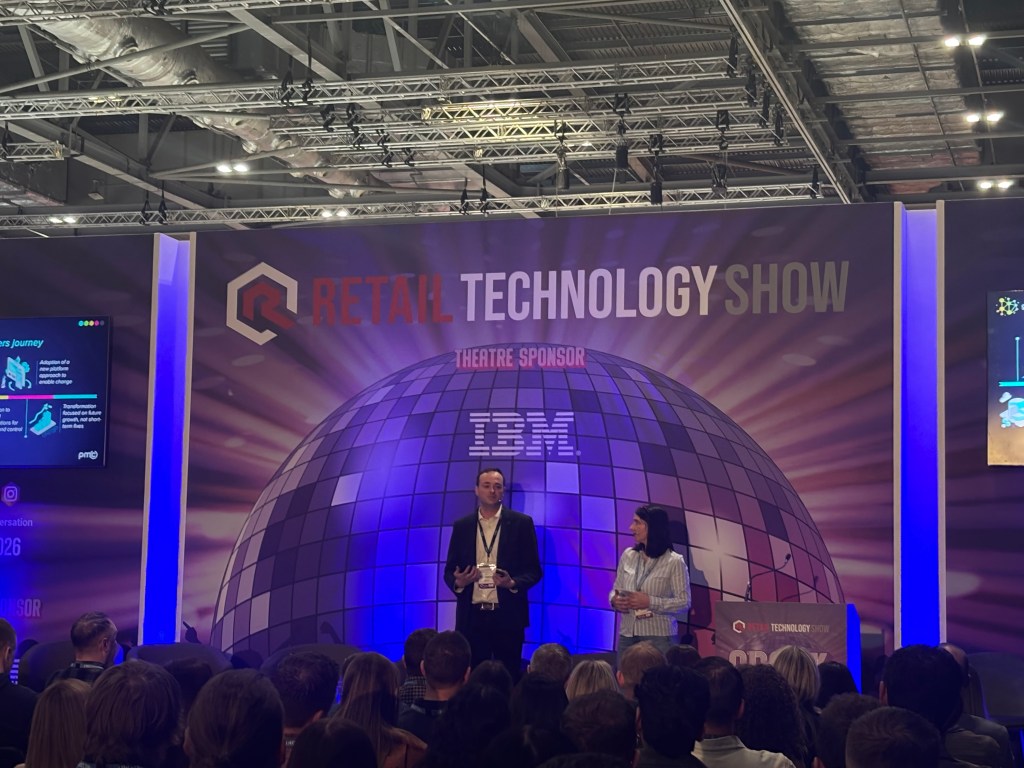
Partnerships and people were key to Ann Summers tech transformation with PMC, the retailer and tech business told RTS delegates on Wednesday 22 April, writes Ben Sillitoe.
Ann Summers’ technology director Jeannette Copeland spoke on Wednesday of moving “the heart and lungs” of the business when undertaking last year’s technology transformation alongside unified commerce IT services provider PMC.
The lingerie and adult toy retailer implemented PMC’s integration platform, aimed at simplifying future tech amalgamations and building efficiencies throughout the organisation. It was an IT modernisation project steeped in the ambition of making the retailer fit for a future and taking away reliance on legacy software and systems.
Copeland was talking on stage at Retail Technology Show 2026, alongside PMC technology and solutions director Elliott Winskill. They used the session to talk through the transformation in detail, which is the result of a two-year partnership.
PMC’s Graphene platform was deployed to help Ann Summers evolve its IT strategy towards a composable commerce, modular-based, microservices approach – and it was a move that will help the retailer across its business functions, from the in-store experience and point of sale to mobile commerce, digital sales and marketing. After an intense piece of work, the result is Ann Summers has a simplified and modern core commerce integration tool that allows it to surface data when and where it is needed.
But both the tech company and the retailer acknowledged it was not easy to implement. Real tech transformation does not come easily, they agreed.
PMC says it is one of the most demanding undertakings it has ever faced. Copeland said that some people in the Ann Summers tech team found it “the hardest thing they’ve ever worked on”.
The previous system in place pulled pushed and transformed data between a range of different in-house and third-party downstream systems including logistics, payments, finance and websites. Like many businesses, it had become a tangled tech web.
“We’d taken to building on top of things, on top of things,” said Copeland, who added that – as is often the case in retail – people with tech responsibility had moved on from the business, taking knowledge with them.
“If you keep building on top of it, it’s like building on sand,” she added, underlining the importance of undertaking the transformational work. “Eventually you need to do something about it.”
PMC worked alongside Copeland and her team to untangle the complex web of data integrations and business logic in place, adopting the approach of transforming the retailer’s enterprise architecture one piece at a time. A reverse engineering approach was required.
Ann Summers can now talk of having a commerce solution that will support its future growth, including simplifying its approach to integrating with multiple marketplaces which is a key part of its current strategy.
PMC’s services team now manages Graphene on Ann Summers’ behalf, taking out previous running costs and lightening the load in terms of overseeing other third-party tech integrations.
Both Copeland and Winskill said it could not have been successfully achieved through the traditional master-servant retailer-tech provider dynamics. Achieving the result they did only happened thanks to a “partnership” model where both retailer and tech provider work in unison, they noted.
Winskill said tech transformation “is a people story first” and trust between partners is “never a given” – it needs to be built and earned.
“We feel as much a part of their business as we do our own,” he added.
Copeland commended PMC’s “tenacity” in tackling what was a hugely challenging transformation. Reflecting on what made it work, she remarked: “It’s always about resource, time, and budget – but most importantly it’s the people you use internally and through partners.”
Editor of Green Retail World, Ben Sillitoe is a freelance editor, journalist and retail tech content producer, who writes for leading publications including Computer Weekly.






Leave a Reply