
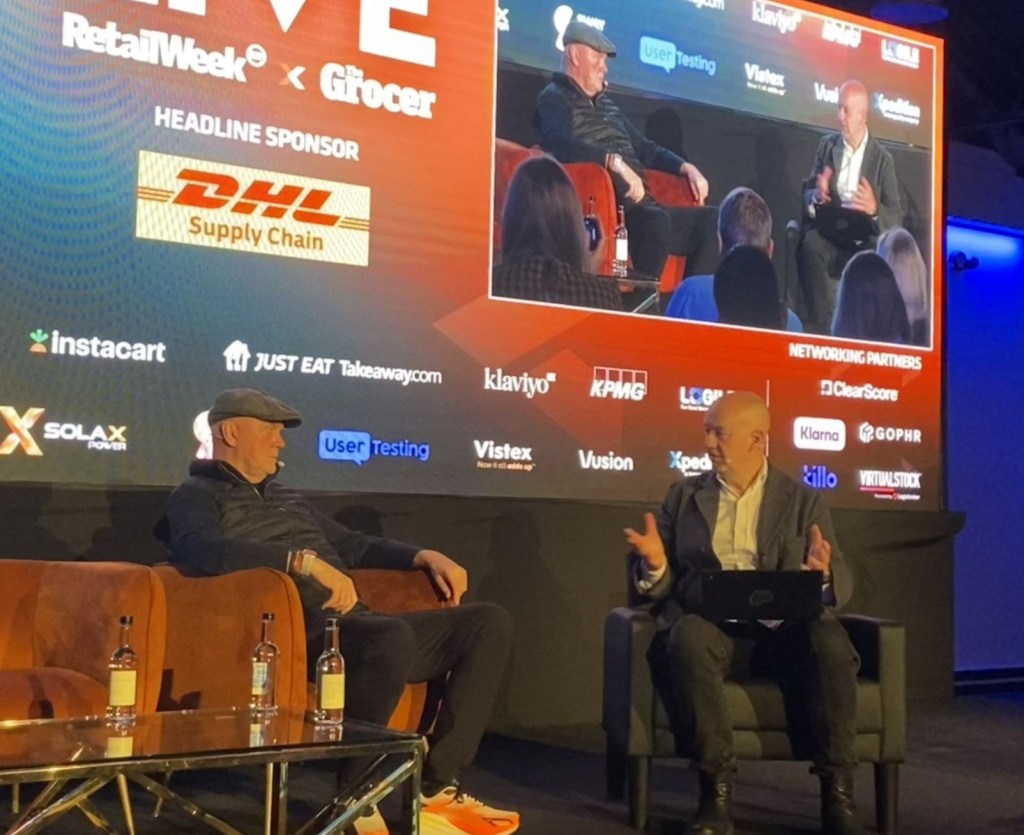
Allan Leighton’s comeback to Asda – and his plans for the supermarket’s turnaround – are less about reinvention and more about rediscovery, he said, speaking at Retail Week x The Grocer LIVE earlier this month.
Joining The Grocer’s Editor, Adam Leyland, on-stage, Leighton said that, despite a complex backdrop of disruption, fragile demand and intensifying discounter competition, rolling back Asda’s fortunes will rely on a steadfast, long-term commitment to customer and colleague centricity.
Culture eats strategy
Leighton re-joined Asda in November 2024, having led the supermarket as CEO between 1996 and 2000. During his first tenure, he orchestrated the business’ turnaround and oversaw its acquisition by Walmart in 1999.
Talking about his return and its current turnaround plans, he was quick to point out that success will rely on collective efforts.
“It doesn’t take one person or two people to turn something around. It takes a lot of people.”
That is why the Asda comeback strategy is underpinned by what he describes as a “timeless principle of two things”: team and customer. “The customer has to be at the heart of every decision you make… and you can never lose sight of that,” he said.
This isn’t just about operations – this sits at the heart of decision-making, from team organisation to hiring strategies. He said those hired into Asda are not chosen based on their CVs, past roles or experiences, but on mindset.
“We don’t hire based on the role that you did or experience. We hire on ‘do you think customer?’”
The concept that ‘the customer is the boss’ is foundational to where the supermarket is anchoring its efforts – which may sound simple, but can be “easily lost” amid operational complexity, he said.
Asda’s next CEO will come from within
Leighton hinted that the supermarket’s next CEO – a closely watched question at Asda – would come from within the business. Pointing to Asda’s most successful period, when its leaders rose through the ranks, he said: “For me, a measure of success is: can you promote from within?”
“The history of Asda is [that] it’s very difficult if you bring somebody in from outside,” he noted, reinforcing his belief that the company’s culture is best understood – and sustained – by those who have grown up within it.
And, with what Leighton describes as a “really talented” executive bench, he hinted there are several potential future leaders and CEO candidates emerging within the business when the time is right.
Playing to Asda’s “unmatchable mix”
Against a backdrop of intensifying competition, especially from the discounters, Leighton says the business is resisting the urge to mimic its value-led rivals.
Having done away with the Aldi price match, Leighton says differentiation – not price – will remain Asda’s greatest strength.
“The thing is not to compete with them,” he argues, but to focus on what makes Asda distinct. “People shop for difference, not for sameness. We need to trade on difference… on our unmatchable mix, [and] not be the same as everybody else.”
This “unmatchable mix” combines the business’ offer across grocery, clothing (via its George brand), general merchandise, fuel, pharmacies, opticians and convenience. Few competitors, he noted, can match that breadth.
Value beyond price
While Asda’s heritage is built on price leadership, Leighton acknowledges that value today is more nuanced. Price, which remains the “bedrock”, is only the starting point.
True value, according to Leighton, is a blend of price, people, proposition and trust.
“The art is to blend all those ingredients into a dish of value. But it has to be a different dish to others.”
“A big part of value is the friendliness of our people,” he said, making store standards, colleague engagement and service just as critical as sharpening Asda’s price offering. From there, he believes value will extend into Asda’s wider offer, into clothing, GM, convenience and fuel, contributing towards its point of difference or ‘unmatchable mix’.
Active listening in leadership
Instilling some of that winning culture and value will require actively listening – or “listening to hear” as he called it – to bring views from the business, particularly at store level, into the boardroom.
This is why he has already brought back colleague circles, spends a lot of his time in stores and has also launched his ‘Tell Allan’ suggestion scheme.
“Tell Allan is not old school – it’s the best thing when you can get suggestions from your colleagues. It doesn’t mean every one is going to be a great suggestion. In fact, they won’t be.
The most important thing is to create an environment in your business where colleagues feel they can make a suggestion. The fact they can is the most important thing, and people miss that.”
Playing the long game: turnarounds take time
Leighton was keen to impress that turnarounds take time: “I can tell the story of the first turnaround in 10 minutes, but it took 10 years in reality.”
Meaningful progress, he suggested, typically takes three to five years before momentum builds.
“We are thinking about building a business for 10 years, not for 10 minutes.”
There are early signs of improvement, as the business “edges forward”, but he remains focused on inputs rather than outputs, including simplifying processes, increasing speed and maintaining motivation.
“If those three things are progressing, I know the outputs will come,” he added.
Data-led retail requires discipline
In line with its renewed focus on customer-centricity, Leighton said Asda is investing more heavily in analytics and shopper insight – but he warned against confusing data volume with insight value.
“There are gold mines and there are coal mines. You can have a lot of data and have no insight.
The most important thing is not to have loads of sludge – you have to get the gold mine data. So mining it in a way [that] affects the business is really important.”
The challenge, he said, is not just collecting data, but extracting meaningful, actionable insight that improves the business.
A business worth fixing
For all the challenges, Leighton remains optimistic about Asda’s prospects and its turnaround.
“We have all the pieces of the jigsaw. We’re just putting the jigsaw together.”
He readily admitted that the process would involve trial and error – and a good deal of patience.
But with a philosophy centred on people, purpose and long-term thinking, Leighton believes the business is not only repairable, but capable of rolling back its fortunes towards sustained success.



 Retail Rewired
Leave a comment