
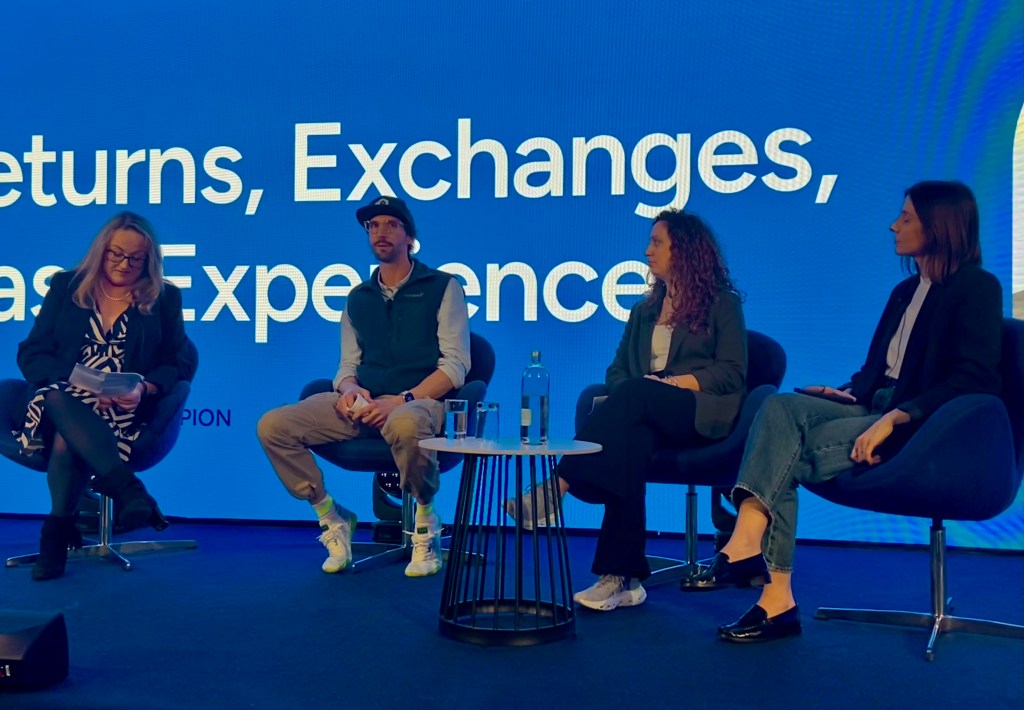
As the role of post-purchase increasingly makes or breaks customer experiences and longer-term loyalty, sports brand On, New Look and parcelLab explored the changing shape of shopping journeys beyond the buy button at The Delivery Conference (TDC) earlier this week.
Joining The Retail Champion, Clare Bailey, onstage at TDC Aura Hita Losa, Conversational AI Lead at On, Daniele Thomas, New Look’s Customer Optimisation Manager, and Tobias Buxhoidt, CEO of parcelLab, discussed how retailers could optimise, personalise and automate post-purchase journeys to meet new shopper demands.
Retail returns need a rebrand
Returns are often viewed by retail businesses as being entirely negative or an inevitable but ‘necessary evil’ of operating online, the panel agreed – and with global returns costing retailers an estimated £656billion annually, it’s easy to see why.
However, within the returns process there are still opportunities to turn an initially negative experience into engagement, additional revenue, brand trust and loyalty – but only if the post-purchase experience is optimised.
“Brands still see returns too negatively,” said parcelLab’s Buxhoidt. Instead, he suggests, they should reframe this perception and consider them a process that “just needs completing” and optimising.
“It’s the end-goal: you used to optimise for the sale, and you optimise for delivery, now you need to optimise for returns.”
On’s Hita Losa agreed, saying that “customers don’t expect everything to be perfect – but they do expect to be taken care of.” With optimised post-purchase journeys – whether that’s via human or AI interaction – if shoppers feel supported, brands move from returns being negative to a more positive experience, she said.
“A return becomes a proof point of how well a brand responds when things don’t go well – and that’s an opportunity to build trust,” New Look’s Thomas concurred.
A milestone in a ‘never ending’ engagement cycle
Central to this returns mind shift is to stop thinking of returns as a “dead-end”, said Buxhoidt, who suggested they shouldn’t be regarded as a final interaction.
The customer journey should never have an end point, he explained, and instead recommends retailers think about returns as “a milestone in a in a never ending journey” where post-purchase experiences bring the customer back into the buying loop time and again.
When post-purchase is optimised and executed well, a return is just as likely to become the start of a new purchasing cycle as when a brand acquires a customer.
“You can’t have dead ends in customer journeys and you can’t stop ongoing engagement with customers – especially the ones you want to keep,” he added.
Extracting rich customer insight from returns data
In addition to opportunities for building brand trust, the panel pointed to the wealth of data that could be extracted from returns – from using personalisation to boost CX and prevent further returns, to shopper preferences and future product development.
Retailers should view returns as as “another customer data point they wouldn’t otherwise have had,” suggests Hita Losa, advocating that returns data is used to improve the shoppers’ next buying experience.
If shoppers have size sampled (buying the same item in multiple sizes), for example, she suggests retailers leverage that signal on sizing uncertainty to build personalised recommendations around size and fit into their next purchase. This would not only improve CX, but prevent friction and future returns occurring.
New Look is using insight from returns data even further upstream, Thomas explained. She said it now uses returns data to engineer new products. This includes ensuring that toxic products or traits that spike returns rates based on real-word customer feedback don’t make their way into future collections:
“We have data scientists specifically looking at our returns data, not just so that we can market better, but also so we can better engineer products to meet customers’ expectations, to prevent [returns] happening upstream.”
Building personalisation into post-purchase experiences
Data could be put to work harder to personalise returns, said Buxhoidt. He described “a huge opportunity” to “move away from a one size fits all” approach to returns.
“Currently, 80-90% of all retailers still have the same returns experience for every single customer – but there needs to be a more nuanced way of handling these experiences.”
This approach could extend to returns charges – where a brand decides whether to invest in a return if it’s a ‘good’ customer or not, perhaps because it’s an unprofitable consumer or serial returner.
Sports brand On is already exploring returns personalisation, and is looking at ways to build a more 1-2-1 experiences based on data and insight.
Hita Losa said this included weighing up fast-track refunds for loyal or VIP shoppers. However she caveated that this relied on having robust enough data – and ways with which to process it – to make those personalisation decisions that benefit the shopper but in a profitable way for the business.
A question of trust
Returns and brand trust are inextricably linked, said Thomas, explaining that New Look’s 10million customers consistently feedback that they want returns policies to be clear, easy to find and transparent.
“They want it to be really clear, but also relatable and not heavily legal sounding, because it can sound quite interrogative to the customer, rather than there to support them.”
Trust is also built out of choice and communication, she said, and that means making returns easy for shoppers with a variety of channels and carriers with which to send items back, as well as keeping customers updated at every stage of the returns journey.
“Communication is really important, and it needs to be optimised and well timed. Silence in returns experiences just causes risk and anxiety for the customer – they feel a lack of control as well as financial vulnerability while they’re waiting for their money back.”
“Under the loyalty equation, it’s got a lot to do with the brand values and your brand promise” and how the brand shows up and acts against that promise, said Buxhoidt. Turning returns into trust and loyalty relies on “using data to create something that feels tailored, personal and emotional,” he said, and “that’s where brands build relationships, trust and everything that comes after.”
AI and a new era of returns experiences
As end-to-end AI buying journeys become the norm, this will significantly impact the shape of returns, the panel agreed.
Rather than all returns being experienced through the same customer journey, Buxhoidt predicts that AI will make returns experiences more conversational – and personal. He said AI chat or voice assistants mean customers don’t have to go through a single pre-defined customer journey, meaning the process can be better personalised depending on the shopper’s individual needs.
Hita Losa also pointed to conversational returns leading to more ‘sale-saving’ resolutions, by “humanising the experience, even thought there is AI behind it” retailers can offer different size options, colourways or alternatives to bring the customer back into the purchasing loop, she said.
AI is also set to dramatically change customer acquisition – which will also change the make-up of post-purchase. As more AI platforms layer in end-to-end shopping experiences, “AI will take over a large share of the traditional acquisition channels we see today,” said Buxhoidt.
Driven by convenience, AI is expected to become the major customer acquisition channel, where once it would have been search or social. This means the customer acquisition funnel – and the path to purchase beyond – could remain entirely generic and untouched by brand experience; retailers will then have little to no control over this new buying journey.
The “only chance” they have, said Buxhoidt, is to make an impression and engage the shopper on their own terms after the buy button. This makes post-purchase engagement critical in delivering brand experiences that drive retention, helping retailers remain differentiated while maintaining brand relationships.
On, New Look and parcelLab were speaking at The Delivery Conference 2026, the leading retail, ecommerce and logistics innovation event hosted by Metapack and ShipStation.




 Retail Rewired
Leave a comment