
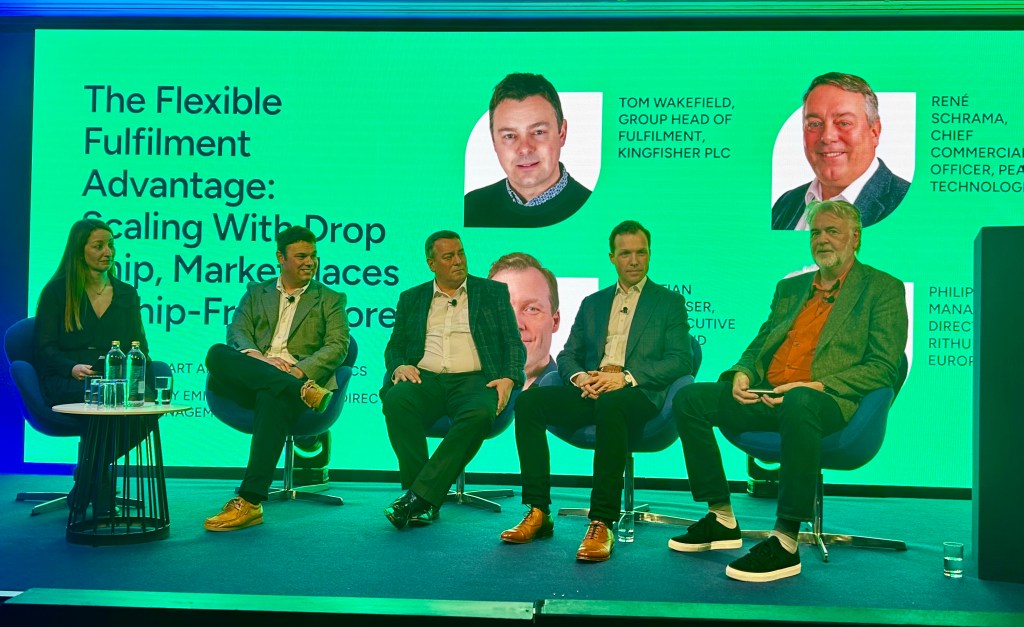
Flexible fulfilment is becoming a core growth lever for retailers, as customer expectations for speed, convenience and range collide with the operational reality of distributed inventory, third-party partners and rising delivery costs.
Tom Wakefield, Group Head of Fulfilment at Kingfisher, joined René Schrama, CCO at Peak Technologies, Philip Hall, MD of Rithum Europe, and Sebastian Steinhauser, CEO & Founder of Parcelly, alongside Metapack’s Senior Director of Product, Emma Clarke, to discuss what it takes to make models such as ship-from-store, dropshipping, marketplaces and dark stores work for retailers, brands and customers.
Kingfisher: convenience for trade, range growth for DIY
Wakefield, speaking from Kingfisher’s multi-brand perspective across B&Q and Screwfix, said the shift towards diversified fulfilment is being driven primarily by customer expectations.
For Screwfix’s trade audience, fulfilment options that keep customers on site are commercially critical. “With Screwfix it’s all about convenience,” Wakefield said. “Time away from the job costs tradespeople money, so ship-from-store is really important.”
He pointed to Screwfix’s Sprint service, which enables delivery within 1-hour, and its 60-second click-and-collect offering as examples of how speed can be used to protect loyalty and win repeat custom.
By contrast, B&Q’s flexible fulfilment strategy is shaped by the need to extend range without tying up capital in inventory. Wakefield said B&Q has leaned into dropship and marketplace models to do this, noting the retailer now offers more than 1.5million products online.
He also drew a clear distinction between the two approaches: dropship enables tighter control through curation and pricing, while marketplace allows faster SKU onboarding by opening the platform to third-party sellers.
However, Wakefield warned retailers not to treat these models as bolt-ons.
“Be really clear on what you expect from stores,” he told the audience. “We’re setting store colleagues up for almost impossible tasks. They’re being asked to become experts in click-and-collect, returns, ship-from-store and products they may not even range.”
Choosing the model starts with the constraint
The panellists agreed that the choice between ship-from-store, dark store, dropship and marketplace should be driven by constraint, rather than trend-led adoption.
Where range and SKU diversity are the challenge, marketplace and dropship can unlock rapid expansion without inventory risk, explained Hall, adding that some of the sports brands that Rithum works with use dropshipping and marketplaces for the ‘backfill opportunity’, ensuring retailers are never out of stock.
Where proximity and speed are priorities – particularly in urban environments – dark store models can be better suited, said Steinhauserm adding that dark store strategies also depend on discipline in execution.
“If you don’t define success upfront, you risk scaling failure,” he said. “You need to optimise locally before you expand, making sure demand, inventory and operations are aligned before rolling out further.”
Schrama highlighted two common drivers behind ship-from-store: managing seasonality and making better use of existing retail footprints.
“Some retailers are using ship-from-store to run down seasonal stock more effectively, rather than discounting,” he said. “Others already have a distributed store network, which is effectively a sunk cost. Leveraging that footprint helps balance capacity during peak.”
Customer experience cannot be diluted
All the five speakers stressed that, from the customer’s perspective, the fulfilment model is irrelevant. A shopper buying via marketplace or dropship still expects the same delivery visibility, post-purchase communication, returns and refunds as they would from traditional warehouse-based fulfilment.
Hall said this had been a critical factor for retailers adopting marketplace strategies. “When we started working with M&S, one of the key requirements was that the marketplace or dropship experience wasn’t materially different for customers,” he said. “You can offer flexibility, but you can’t reduce service standards.”
Hall added that execution often matters more than ownership. “We have customers where NPS scores are actually higher through marketplace or dropship than through their own warehouse operations.”
“You have to be clear on delivery expectations, reduce split deliveries and get post-purchase messaging right. The complexity increases when you have a physical element too, like a customer returning a product to a store colleague who didn’t even know you sold it,” added Wakefield.
Returns were highlighted as a particularly sensitive part of the journey.
“The emotional experience is completely different,” said Schrama. “When you buy something, you’re excited. When you return it, you’re already annoyed. Taking friction out of that journey is critical.” He noted that enabling exchanges across channels adds operational complexity, but is essential to maintaining trust.
Measuring success
When asked how retailers should assess performance, Wakefield pointed to three core KPIs.
“First is OTIF (on time in full), measured consistently across channels, especially when partners are self-reporting service levels. Second is Net Promoter Score and customer sentiment. What is the customer actually feeling and saying about your brand?”
“Third is profitability. I look at contribution margin by channel, because that’s where it gets interesting. You can trade up or trade down fulfilment routes to drive profitability while still meeting service levels,” he added.
Others said marketplace and dropship introduce additional metrics, including time-to-online, product data accuracy and supplier performance management, with poor data quality quickly undermining both conversion and post-purchase experience.
For Hall, supplier execution is now inseparable from brand reputation: “your suppliers are effectively part of your operation – their performance becomes your customer experience.”
Kingfisher, Parcelly, Peak Technologies and Rithum were speaking at The Delivery Conference 2026, the leading retail, ecommerce and logistics innovation event hosted by Metapack and ShipStation.



 Retail Rewired
Leave a comment