
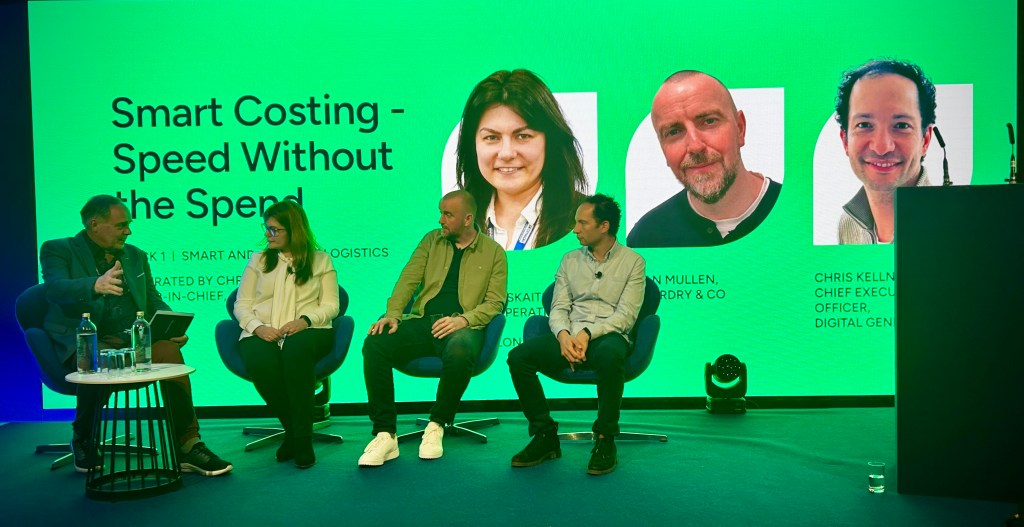
AI-driven customer service automation has been one of the earliest and most widely adopted retail use cases, but as integration becomes more mainstream, what are the real-world successes and challenges for those on the customer service coalface?
Chris Dawson, Editor in Chief at ChannelX, hosted a panel earlier this week at The Delivery Conference, exploring the reality of automating post-purchase and delivery-related CX workflows.
He was joined by Oksana Dambrauskaite, Digital Operations Leader at Decathlon UK; Allen Mullen, Customer Service and Business Change Lead at Superdry & Co (Superdry); and Chris Kellner, CEO at Digital Genius, an AI-powered CX and support platform.
Customer expectations keep rising
Constantly rising customer expectations are, perhaps, the only true constant in an increasingly complex retail trading environment. Any deviation from perfect, seamless CX can lead to complaints, negative feedback and lost loyalty – all of which significantly impact retailers’ performance and margin.
“Customer expectations are higher than ever,” said Superdry’s Mullen. “Ecommerce should be simple: you buy something, it gets delivered when you expect it. But when it goes wrong, there’s the cost of the customer service team, the technology behind it, and often compensation too.”
“After spending so much money acquiring customers, if you don’t deliver a good experience, they simply won’t come back,” he added.
The reality of Peak pressure
Increased demand across Peak Trading creates additional strain, said Digital Genius’ Kellner.
“There are so many points of friction in the delivery journey – warehouses, carriers, doorstep delivery,” he said. “During Peak, everyone thinks they’re ready, but something always pops up. That’s when you see huge spikes in contact volume, and for customers the experience is usually poor.”
Dawson, keen to understand – given the proximity of The Delivery Conference to the Christmas trading period – asked how Peak 2025 had been from a customer service perspective for both Decathlon and Superdry.
For Dambrauskaite, advanced planning meant that while there were operational issues behind the scenes, they didn’t spill over into CX.
“Peak can go wrong in so many places – the carrier, the warehouse, or even the website. This year we worked closely with our delivery partners and we planned for every scenario. We did have some operational issues, but they didn’t reach the customer, because our contingency plans absorbed them,” she said.
“One of our biggest successes over peak was using AI-generated responses,” said Mullen, adding that Superdry had invested heavily in customer service automation. “Instead of just sending a tracking link, we can now say: ‘I can see your order was updated yesterday and is due to arrive on Thursday.’ That extra context reassures customers and removes a lot of pressure from the contact centre.”
However, he said there were still learnings, particularly around the importance of accurate delivery tracking and partner performance within the complex customer delivery journey.
“Tracking data is often unreliable,” Dambrauskaite pointed out. “If the information is wrong, neither the customer nor automation can make sense of it. Most customers won’t know to go and check the carrier site – they just feel stuck and frustrated.”
She also highlighted the importance of choosing the right delivery providers: “Customers buy from you, not the carrier – so if something goes wrong, it’s your brand that gets blamed. You might pick a cheaper partner, but how much will you end up paying in collateral damage when service fails?”
Automation reshapes the contact centre
Asked whether customer service could ever be fully automated, both Mullen and Dambrauskaite agreed that, while automation was significantly reshaping contact centres – from skill sets to staffing levels and the type of work being carried out – there would always be a need for human agents.
“I don’t think automation will fully replace people, because some customers still want to talk to a person. Even if a bot sounds human, people aren’t always comfortable with that – we’re not fully ready for it,” said Dambrauskaite.
However, comfort levels with automation are rising, often driven by a desire for faster resolution. “Customers want answers now. If technology can provide fast, high-quality information instantly, what’s the difference from a human response for straightforward queries?” she added.
Asked how he knew when automation had gone too far, Mullen said: “I always watch phone demand closely. As soon as customers start asking, ‘why don’t you have a phone number?’, I know something isn’t right. That tells me we’re not delivering the digital experience properly.”
Decathlon does not offer a customer service phone line, and Dambrauskaite said customers generally don’t notice as long as service is fast and effective. She noted that many of its shoppers prefer channels like WhatsApp or Messenger because they’re not stuck in a queue and messages don’t disappear.
“We’re looking at phone contact differently now, she explained. “Instead of making people wait 20-30 minutes during peak, customers can book a call-back for a day and time that suits them. The challenge is meeting that demand – if the schedule fills up a week in advance, the call-back experience stops being helpful.”
Discussing the operational impact of automation, Mullen said skill sets and roles were evolving alongside AI. “The contact centre might be smaller, but the work is more complex. AI handles the repetitive queries, so [human] agents deal with the harder cases – which means you actually need higher-skilled people.”
“Now, I’ve got team members becoming prompt engineers. They’re teaching themselves how to build use cases and deploy them. People who were on phones a few years ago are now shaping how the technology works,” he said.
Ultimately, automation is enabling Superdry to handle more work with the same number of customer service staff.
Where retailers should begin
When asked where retailers should start, Kellner was clear: “deliveries, out-of-stock items and returns are the most obvious areas for proactive automation. Customers want to know when their order will arrive, when they’ll get their refund, or if something is unavailable – these shouldn’t require a manual interaction.”
Dambrauskaite agreed, recommending retailers begin with low-value, repetitive tasks.
“If your team is pressing the same button and sending the same template ten times a day, they shouldn’t be doing that. We began with straightforward, repeatable processes – like standard returns steps – and automated those first. Then we expanded from there.”
Both were adamant customers would ultimately determine whether automation was working.
“Customers will tell you if it’s working – through satisfaction and feedback. The contact centre is one of the richest sources of insight, [revealing] why customers are contacting you and what’s frustrating them. If you’re not learning from that, you don’t understand your customer,” concluded Dambrauskaite.
Decathlon, Superdry & Co and Digital Genius were speaking at The Delivery Conference 2026, the leading retail, ecommerce and logistics innovation event hosted by Metapack and ShipStation.





 Retail Rewired
Leave a comment