
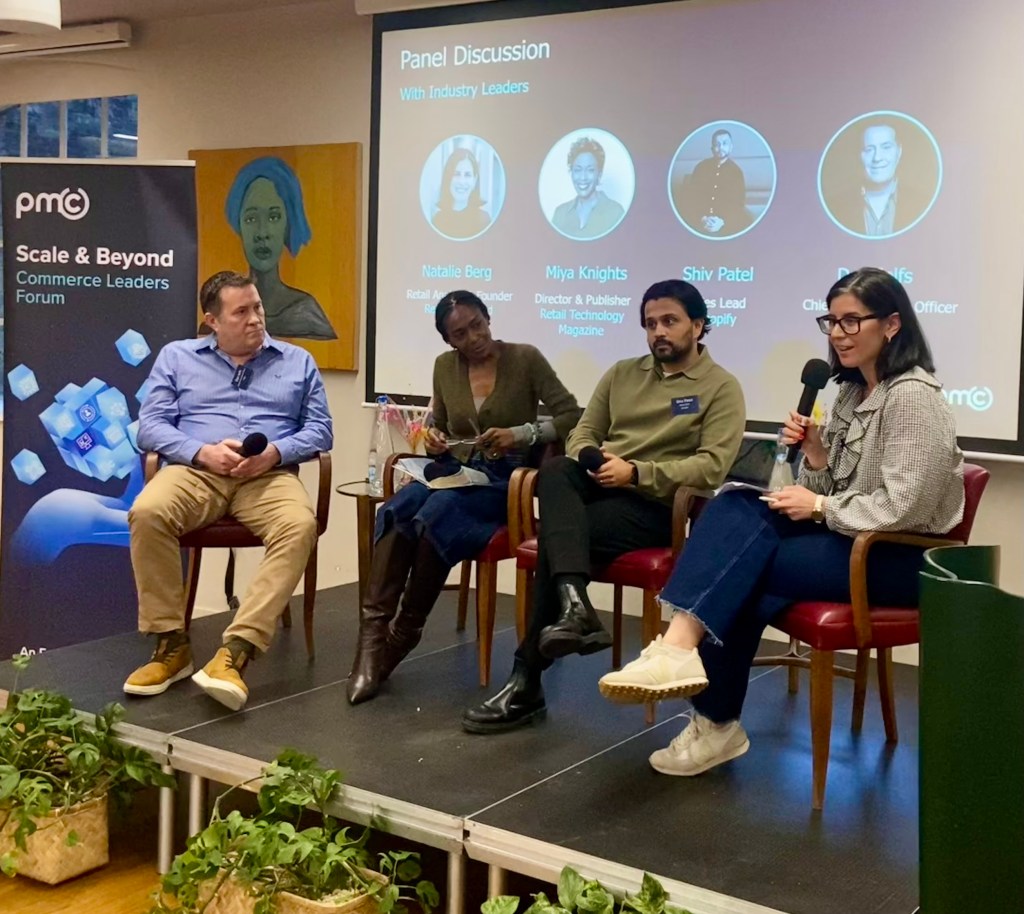
Earlier this week, PMC‘s Commerce Leaders Forum brought together leading retailers and brands and retail technology experts, including Katie King, Miya Knights, Natalie Berg and Richard Lim, to discuss unified commerce, AI-driven growth and practical strategies for scaling retail globally.
As growth becomes harder, innovation is non-negotiable
Across the sessions, the speakers weren’t shying away from reality of the economic backdrop facing retail; softer demand, heightened consumer caution and purchasing hesitancy are set to remain for some time to come.
Miya Knights, Publisher of Retail Technology magazine and editor of newly launched AI title, The Promethean, pointed to the latest Retail Think Tank (RTT) forecast. The RTT predicts retail sales growth will stagnate in the first quarter (Q1) of 2026, as rising household essential costs, concerns about the economy and prioritisation of discretionary spend dampen demand.
She also said that demand was shifting as consumers’ value equations have changed: “we’ve moved past the era of ‘peak stuff’ and peak saturation,” prompting consumers to search for reasons to buy driven by value.
However, in spite of – and perhaps even because of – these shifts and pressures, retailers needed to “move beyond utility mode” and “right size their [tech] investments” to meet the opportunity and “fight harder for spend,” according to Knights.
This was echoed by PMC’s CCO, Dan Jelfs, who said sector shifts meant retailers couldn’t afford to delay on strategic transformation, advocating brands “be brave, be bold and invest ahead of the market.”
Infinitely complex customer journeys
Further to ongoing economic challenges, Retail Economics‘ Richard Lim also outlined the impact of the growing complexities of customer journeys.
He said these would only become “infinitely more complex” as the emergence of new channels, new retail formats including resale, and rapid adoption of AI evolves shoppers’ paths to purchase.
And these increasingly “exacting expectations” on top of more complex buying journeys are prompting the need for change, forcing retailers to reassess – and address – the gap between their unified commerce ambitions and current execution, Lim said.
Knights concurred, adding that retailers needed to be “clear on purpose and value” wherever they show up, regardless of touchpoint.
Back to basics: the fundamentals powering retail agility
Demonstrating ROI remains the top challenge for retailers in driving innovation forwards, Lim said, with the economic backdrop, softer consumer demand and a wave of rising costs, such as NICs and business rates reforms, placing addition pressures on competing priorities.
“This year will be another year of navigating disruption,” agreed Retail Disrupted podcast host, Natalie Berg, “but retailers will still need to make targeted strategic investments.”
“Retailers face a trade-off between the need to invest in innovation versus other, often competing, business needs around cost saving and margin protection,” Lim explained. And this, he said, required a ‘back to basics’ approach, focused on setting – or resetting – digital foundations, fixing and removing siloed legacy systems and moving towards a more modular approach.
A back to basics mindset was also advocated by Katie King, who said in her keynote presentation that, even as retailers turn towards AI as a growth engine, they must first fix the fundamentals:
“No AI will put a gloss over flaws in the fundamentals of a business… if the ‘glue’ is missing between the tech and the tools, retailers miss out on the true realisation of AI.
King added that “AI is only powerful when the foundations are right – only then will retailers be able to tap its advantage.”
Complexity is universal
Pointing to the latest research in PMC’s Race To Unified Commerce report, which was conducted in partnership with Retail Economics, Lim outlined the growing need for retailers to integrate core systems to meet rising pressures.
By unifying the foundation layer of systems, such as ERP, OMS, CRM and POS, retailers can move towards a single flow of data to support decision-making.
While 96% of Direct-To-Consumer (DTC) brands polled in the report have already moved towards or achieved core integration – perhaps an easier task for younger, predominately online businesses with simpler tech stacks – omnichannel retailers were lagging behind. Hindered by legacy drag and weighed down by architectural complexities, the report revealed that only 38% of omnichannel retailers had realised full integration of their core systems.
“Complexity is universal,” PMC’s CEO Richard Lowe added, which means “harder and faster investment” to “close the gap between [retailers’] plan, vision and execution… so they’re ready to flex to take advantage of the opportunities available.”




 Retail Rewired
Leave a comment