

Trump’s tariffs on British goods, combined with the removal of the de minimis threshold, are increasing costs and complexity for brands selling into the U.S.
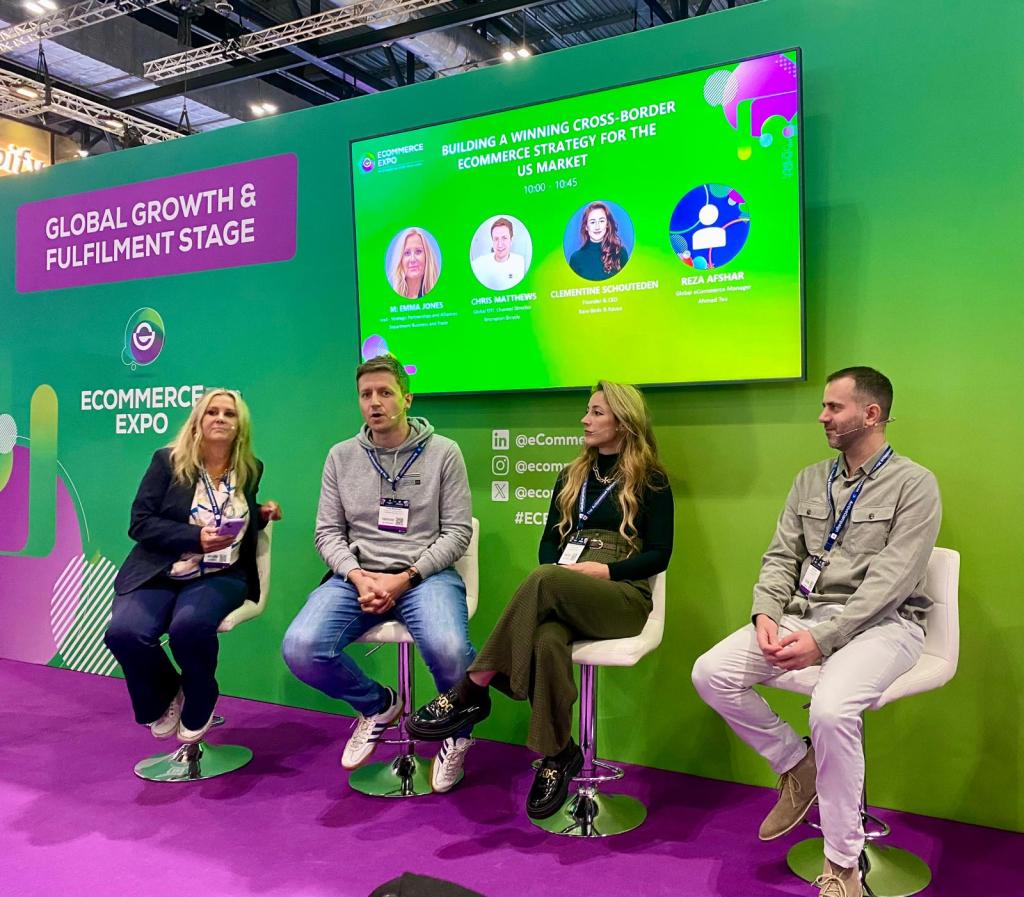
Speaking at Ecommerce Expo 2025, Brompton Bikes, the iconic folding bike brand, the fast-growing pet brand Kavee, and family-owned British tea company, Ahmad Tea, shared how they have built successful ecommerce strategies to overcome the challenges and capture growth across the Atlantic.
Selling into the U.S. – different routes to market
While each of the businesses took different routes into the U.S., reflective of the sheer scale of the population, the physical geography and the marked differences between individual states, the lesson was clear: there is no single way to approach launching into the market.
Clementine Schouteden, Founder and CEO of Kavee, has been selling in the U.S. for five years. She initially serviced American customers from the UK using a third-party logistics provider and shipping all products stateside. “It was a good strategy for testing the market, but we quickly hit a ceiling. Delivery fees were very high and we couldn’t offer U.S. customers the value and experience we wanted,” she explained.
The business found itself in what Schouteden described as a “catch-22” situation. She said: “we couldn’t find a local 3PL to service the market because we didn’t have the necessary volume, but we couldn’t reach that volume servicing from the UK.” The breakthrough came when the brand partnered with Launchpad Logistics, which did not require a U.S. entity to take on the business. “That local service meant we could finally offer a competitive proposition [for] fast deliveries.”
When Ahmad Tea, launched in the U.S. fifteen years ago, Reza Afshar its Global Ecommerce Manager explained, it began with its own website before quickly pivoting to include Amazon. “With an average product price of $3.50, volume was essential. Amazon gave us that.”
Afshar also noted that the vastness of the U.S. market meant the brand had to find a niche to be competitive, with loose black tea as its core proposition.
Chris Matthews, Global DTC Channel Director at Brompton Bikes, explained the brand took a physical-first approach. “We launched in 2015 with one person in California focused on securing retail partners. With a product like ours, customers needed to see it physically.”
The business set up a U.S. entity and office in New York in 2017 and launched ecommerce and DTC. The halo effect of its retailer-driven brand visibility meant ecommerce was instantly successful. Today, ecommerce is Brompton’s biggest U.S. sales channel, with retailers providing crucial after-sales support.
Tariffs: challenge and opportunity
When it came to Trump-era tariffs, experiences varied – but the impact was universal. Afshar said the unpredictability made strategy difficult, saying “the reality is we are just waiting it out.” The business has reduced the number of shipments, from seven to just three, made them bigger and stopped just-in-time deliveries. “At one point our goods were stuck in port for two months because there were no trains or lorries,” he said. Ahmad Tea has since moved its U.S. warehouse from Texas to Michigan to help streamline logistics.
For Schouteden, tariffs accelerated the need to hold stock in the U.S. “Serving the U.S. from the UK was impossible,” she said. While the transition was stressful, the silver lining was an improved value proposition with no tariffs and fast shipping.
Brompton faced added complexity due to product categorisation. “Our bikes are made in the UK, but our accessories are made in China, so different tariffs applied,” said Matthews. He noted customs brokers became essential for advising on the most cost-effective way to get product into the market.
He added that the brand turned pricing pressures into an opportunity:“we pre-warned customers of an April price increase and saw a huge uptick in sales beforehand. There was still a hit on the P&L, but it wasn’t insurmountable.”
Localising for the US consumer
Despite ten years in the market, Matthews admitted Brompton is still fine-tuning its marketing. Its paid media is state-focused rather than national, and Reddit has emerged as a huge community for the brand. “Getting influencers onto Reddit has had a big impact for limited spend,” said Matthews. While the brand does not translate its website into Spanish, it now offers Spanish-language customer service.
Schouteden was frank about the cultural gap. “UK content doesn’t resonate in the U.S.” because American consumers have been “trained by Amazon Prime.” This means they care more about promotions, discounts and endorsements. By contrast, UK consumers are more receptive to educational content.
At Ahmad Tea, Afshar said the brand has had to overhaul its Amazon product pages. “American customers want to understand how the product will improve their lives. They want far more detail on ingredients, benefits and even the geography of where the tea is grown.”
American consumers require far more post-purchase engagement, Afshar explained, something that can be difficult to provide on a third-party marketplace. Ninety per cent of Ahmad Tea’s U.S. sales are through Amazon. The brand has resolved this by including QR codes on its packaging to tell its brand story and to capture first-party data.
Advice for brands heading stateside
Each panellist offered advice for businesses eyeing the U.S., with Matthews stressing the need for clear strategy. “Hyper-localising content and structuring your business properly is critical. Without that, you can waste money fast.”
He also shared a logistical lesson: “Avoid using a 3PL on the East Coast. The costs are huge. We moved to the Midwest and saw immediate savings.” The brand is now preparing to offer next-day delivery nationwide through FedEx.
Schouteden warned against international expansion for its own sake, saying “your brand has to be strong at home first. Otherwise, it becomes a vanity project.”
Afshar highlighted the importance of managing expectations internally. “Stakeholders often want instant growth and profitability; having a strong internal programme to manage those expectations is just as important as your external strategy.”


 Retail Rewired
Leave a comment