
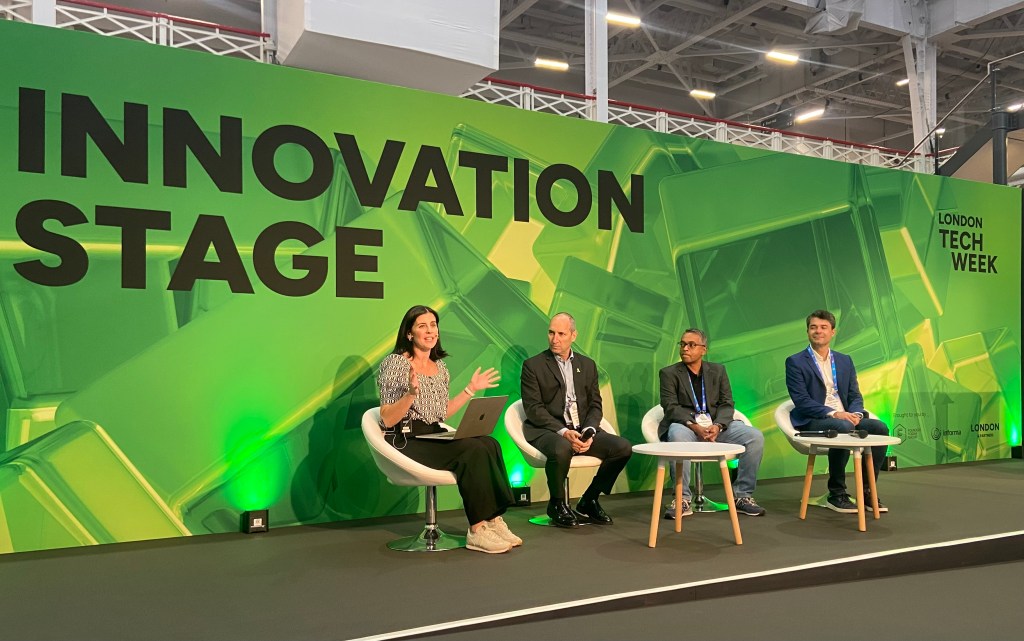
Hot off the retail track at London Tech Week, we caught Natalie Berg’s session on the evolution of supply chains, which saw Tesco, Unilever and DHL take to the stage to discuss key challenges facing modern supply chains and the technologies driving greater operational resilience and agility.
Availability and consumer demand among key challenges
Replenishment and product availability may be some of the very last stages of the supply chain but, because they are customer-facing, they are one of the key focus areas for Tesco, its Head of Product, Kuru Subramaniam, revealed.
“Our supply chain impacts a lot of families and any out-of-stocks or issues with product availability causes disruption to our customers,” he said, making it a core focus for the retailer. Original research of over 100 senior UK retailers by Pricer earlier in May showed that product availability is the top in-store challenge retailers are looking to address this year. Availability issues remain a key customer experience challenge in-store, with customers finding almost a fifth (18%) of the items in their weekly food shop out-of-stock.
As well as being a customer-facing issue, Subramaniam added that product availability was an even greater challenge for grocery retailers, due to short shelf-life spans and tight margins. This makes ensuring stock is available for customers to buy on shelf a critical component.
“Being a grocer, we have – quite literally – very little margin for error in getting supply chain operations right. Our products have short shelf-life spans and we’re already operating on razor thin margins.”
Kuru Subramaniam, Head of Product, Tesco
Fluctuations in consumer demand, which are becoming more volatile, was another key challenge facing retail supply chains, according to Unilever‘s Vice President of Global Customer Operations, Francis Castro.
He explained that, as a CPG which operates internationally, changes in consumer demand, which can come from a myriad of sources, can have a significant impact on its business processes. Whether it’s a product suddenly going viral due to online influencers to macro-level geo-politics and international trade tariffs, even small actions can have seismic impacts on supply chain operations.
Collaboration unlocks supply chain effectiveness
Creating supply chain effectiveness is no longer a solo effort according to the London Tech Week panelists. “You are no longer competing against other people’s supply chains,” Castro said. “Traditionally, you could look at efficiencies and compare yourself to others, but now a much more collaborative model is needed.”
This is because, as complexities grow, retailers need a more extended view of their entire supply chain and any disruption within it, either from customers or suppliers. Partnerships are now key in creating increased resilience.
“Planning for disruption can be hard, but getting yourself out of that disruption can be even harder,” echoed Subramaniam. He pointed to the recent example of M&S and the long-tail fallout to its operations and product availability following a cyber attack. “You’re only as strong as your weakest partner, so collaboration to build in resilience across supply chain ecosystems is vital,” he added.
From Just In Time to Just In Case: a more ‘paranoid’ approach
“We learned during covid that single source supply is not the future of the supply chain,” Saul Resnick, CEO UK&I of DHL Supply Chain, said. And this is why retailers have adopted more near- or omni-shoring of products and are increasingly adopting a contingency-focused mindset.
“Disruption is harder to manage, so retailers have moved from Just In Time to Just In Case models,” Subramaniam explained. “Preparedness is now key and retailers need to be much more paranoid – taking into account the possibility of many layers and facets of disruption – in order to adapt supply chains for the current business landscape.”
However, Resnick caveated that while retailers have moved towards a more precautionary model, this too will have a shelf-life. “As time passes and events or risks that were factored in potentially don’t materialise, businesses will re-assess the need for certain elements of the Just In Case model.”
Creating a virtuous cycle of supply chain sustainability
“Traditionally supply chain success was based on three fundamentals; availability, product quality and cost efficiency,” said Subramaniam. But he warned that this is no longer enough. Instead, retailers also now need to build in three more things – agility, resilience and sustainability – in order to succeed.
Linked to sustainability, transparency is now a key customer demand, with shoppers more tuned into the sourcing, provenance and the sustainability credentials of the products they buy. For Castro, this requires end-to-end supply chain visibility. AI and cloud will help accelerate this, he suggested, providing a platform to create more visibility across the entire supply chain.
“Transparency enforces greater sustainability, which then in turn demands greater transparency, so the two act in a virtuous cycle where one accelerates the other, which can only be a good thing for decarbonisation.”
Francis Castro, VP of Global Customer Operations, Unilever
“This not only benefits the environment, but it can help reduce costs and create greater resilience within distribution, so it works at an environmental level but also at a business and profit level,” Castro added.
From AI to digital twins and robotics, tech sits at the centre of supply chain evolution
For Subramaniam, technology sits at the heart of solving supply chain challenges.
He pointed to the growing maturity of AI and ML, which he sees as a significant opportunity to build systems that can be more predictive about where and when disruption may occur. This foresight will enable retailers to simulate consequences, which is where digital twins can help plan a response for any given situation.
Resnick agreed that digital twins can be useful in understanding ‘what if’ scenarios, but he caveated they are currently in their infancy. He believes AI and robotics present more immediate advancement opportunities.
“AI will help drive visibility within the supply chain, with real-time data on forecasting allowing retailers to be more predictive. Robotics will also propel supply chain operations forward, replacing manual activities in the warehouse and transporation,” Resnick said.
He hinted that this step-change of increased robotics is already underway, and teased that DHL Supply Chain will deploy the first of its Stretch Robots, which automate the unloading of trucks and containers, with a major UK grocery retailer soon.
Catch full session highlights on the Retail Disrupted podcast
You can also catch more highlights from this session on the Retail Disrupted podcast in the coming weeks: Retail Disrupted: A podcast that helps you navigate the future of commerce.
Hosted by retal analyst, Natalie Berg, the Retail Disrupted podcast unpacks the latest trends and innovations in retail, featuring discussions with luminaries including retail CEOs, business leaders, disruptive brands, analysts and tech experts.



 Retail Rewired
Leave a comment