
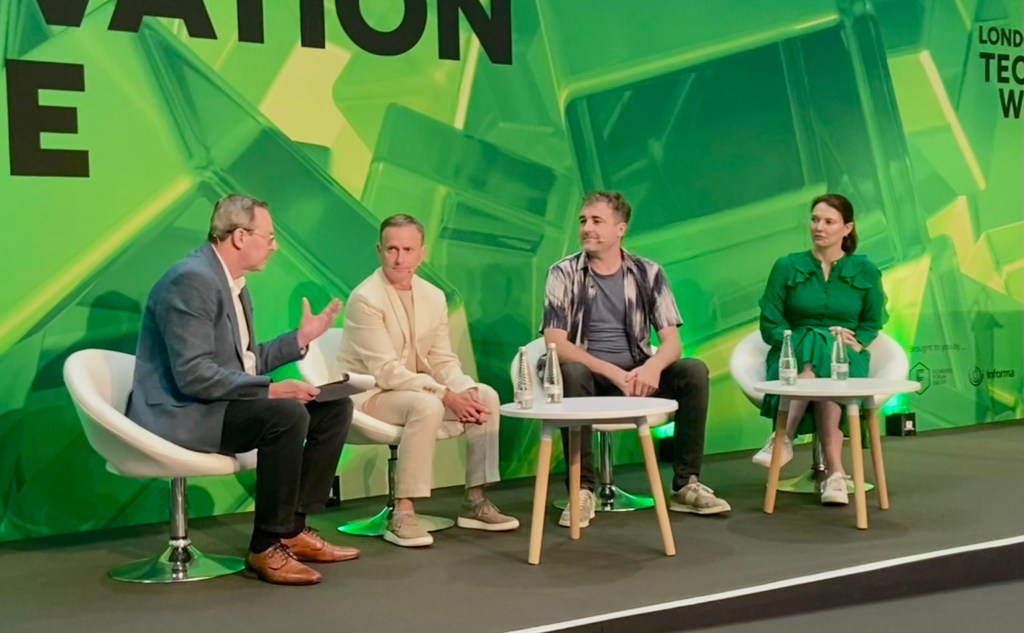

With London Tech Week hosting a dedicated retail track for the first time this year, we caught Andrew Busby’s session on the future of the customer as he asked retail leaders from H&M, Virgin Atlantic and Deliveroo what is driving consumers’ evolving demands and if we’re any closer to uncovering what customers really want?
Setting the scene, Busby asked how retailers can know what their customers are looking for when we, as shoppers, tend to be fickle, inconsistent and increasingly less loyal – and, actually, we don’t really know what we want as consumers ourselves. He outlined a list of rapidly shifting demands – from friction-free shopping to convenience, hyper-personalisation, sustainability and authentic brand experiences – and asked where retailers should start.
Balancing innovation with consumer demands
Virgin Atlantic‘s Head of BI & Advanced Analytics, Tom Barber, explained that while its customers’ demands are rather logistical – essentially flying from A to B – this doesn’t mean they expect any less; “their buying journeys are still experience-first” he explained. And this experience will be nuanced for each customer, he said, whether its a business traveler wanting reliability or a leisure customer going on holiday to make memories – context matters in building out experiences that meet each shoppers’ unique demands, he said.
For H&M, balancing innovation with consumer needs is about understanding how customers shop and interact with the brand across its sales channels.
Its CTO George Mudie outlined how, for the last three years, the fashion retailer has doubled down on its omnichannel experiences in order to optimise how it builds tech into its stores. It uses analytics and data to inform how it augments the shopping experience towards customer needs in-store and where technology fits into that buying journey.
“By treating our stores in the same way we treats our ecommerce, we actually get more data from our stores than we do from our websites,” Mudie added.
Convenience is table stakes for consumers
Convenience is tables stakes for customers, according to Hayley Ward, Director of User Research and Insight at Deliveroo. Innovation around convenience is at the heart of Deliveroo’s business, whether that’s adding new retail partnerships outside of food delivery, such as Screw Fix and Maplin, or innovating new services.
Just last week, for example, Deliveroo launched its new drone delivery service in Dublin to bring food deliveries to customers’ doorsteps in as little as three minutes.
The drones can reach flying speeds of up to 80kmph, and each drone is equipped with safety features including back-up systems and a parachute. Upon arrival, the drone hovers above customers’ driveways or gardens, lowering the food order on a secure, biodegradable tether.
Using data for demand-driven tech deployments
H&M take a very considered store-by-store approach to augmenting customer experiences with tech.
Take for example its Soho NYC store, which includes recommendation mirrors in its fitting rooms, as well as using tech to inform VM, leveraging sensors to analyse dwell time and movement around the store.
It will test out tech and run experiments to see what engages customers within each store and match the technology to customer need and demand.
Human-led tech experiences
Despite rising AI adoption and use, the future of customer experience is human-led, tech-empowered. “While Deliveroo is a tech brand first, we know digital won’t ever fully replace physical, human contact,” Ward said.
Similarly, while Virgin is digitalising customer experience, it is more often the human-to-human interactions flyers have with Virgin Atlantic’s staff – from cabin to ground crew – that shape positive brand experiences, Barber noted.
“The balance can be difficult, but for us it is about thinking human-to-human first, and then layering over digital interactions and technology to augment those customer experiences,” he said. This could be looking at where tech can reduce friction, i.e. scanning passports on digital apps, but doesn’t take away from where human interaction delivers value.
“Everyone comes to us with digital expectations, but they don’t want their experiences to be devoid of human interaction,” said Barber.
 Retail Rewired
Leave a comment